James Bond arrived in video games long before Pierce Brosnan picked up a controller. The secret agent's interactive history stretches back over four decades, tracing a surprisingly chaotic path through every gaming platform imaginable, complete with unlicensed knockoffs, mislabeled spies, and speedboat shooters that barely qualified as Bond experiences at all.
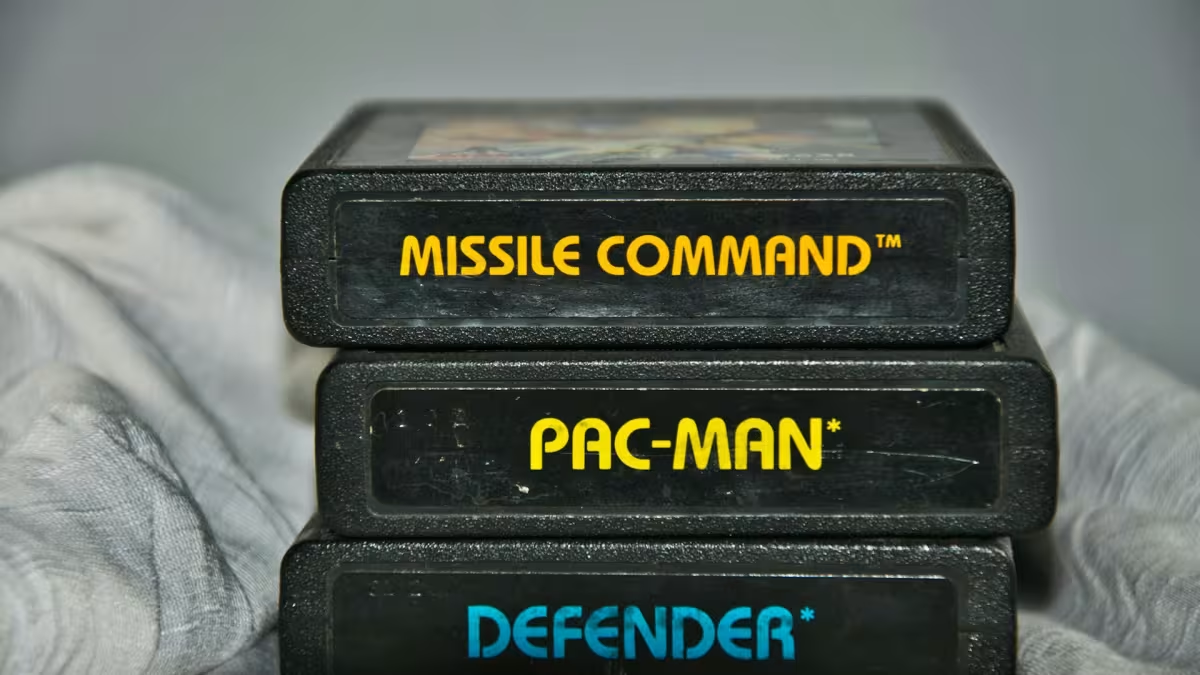
The first James Bond game hit shelves in 1982, though not quite how most players remember it. Richard Shepherd Software released Shaken but Not Stirred! for the ZX Spectrum, a text adventure that never actually secured the Bond license. The game was immediately reissued under a new title, Super Spy, after Parker Brothers acquired the official Bond video game rights. Parker Brothers had recently secured lucrative Star Wars gaming rights and saw Bond as another hot property to exploit. By 1983, the American toy giant released James Bond 007, the first officially licensed Bond game, rolling out across Atari, ColecoVision, Commodore 64, and Japan's SG-1000 Sega console.
James Bond 007 was a side-scrolling vehicle shooter with three or four levels, loosely inspired by moments from Bond films released between 1971 and 1981. Players controlled a transforming car that spent most of its time operating as a submarine. The game was derivative, playing like a short clone of existing vehicle shooters, but it delivered something crucial: the Bond theme, heard in a video game for the first time.
Throughout the 1980s, Domark Software became the publisher of choice for Bond games, dominating home computers with multiple approaches. A View to a Kill arrived in 1985 as both an action game and a text adventure, with the latter written by Raymond Benson, who would later take over the Bond novel series. The Living Daylights in 1987 marked a considerable step up, featuring a traditional shoot'em up structure that actually mirrored the film's plot and offered weapon selection between levels.
Not every Domark Bond game was legitimate. In 1988, the company released a speedboat shooter called Live and Let Die that barely resembled the actual film. Domark had discovered an existing shooter called Aquablast from Elite Systems, slapped a 007 logo on it, and shipped it out. The result was a four-level game that spent most of its time in the Sahara Desert and North Pole, nowhere near the thematic setting of the Bond film it supposedly represented.
Licence to Kill in 1989 tried yet another formula: a top-down, vertically-scrolling shooter. That same year saw a light-gun version of The Living Daylights bundled with the Amstrad Spectrum +2. By 1990, The Spy Who Loved Me arrived as a Spy Hunter clone, complete with a funkiest-ever remix of the Bond theme that pulled from Run-D.M.C., Rob Base, and DJ E-Z Rock.
The early 1990s saw Bond games become increasingly strange. Interplay released 007 James Bond: The Stealth Affair in 1990, an officially licensed point-and-click adventure that had previously shipped as Operation Stealth with a CIA agent named John Glames. For North America, Interplay simply swapped the protagonist's name to Bond while keeping his CIA affiliation intact. James Bond Jr. arrived on Nintendo in 1991 and the Super Nintendo in 1992, based on a cartoon about Bond's nephew despite Bond being canonically an only child with no siblings.
1992 saw Domark release its final Bond game, James Bond: The Duel, featuring Timothy Dalton years after his last film appearance. It was an original story, not based on any existing Bond property, and served as a passable action platformer despite its indefensibly dull title. The game mechanics were serviceable, though health restoration through rescuing blondes proved hilariously seedy.
Author Emily Chen: "The early Bond games reveal a franchise that understood licensing meant something but hadn't figured out what made games actually work yet."
Comments