Football games were not always the incremental annual affair they have become. From the 1980s through the 2010s, soccer sims underwent genuine revolutionary leaps, with certain innovations so consequential they reshaped how millions play the sport virtually. Some transformed the genre overnight. Others revealed their genius only in retrospect.
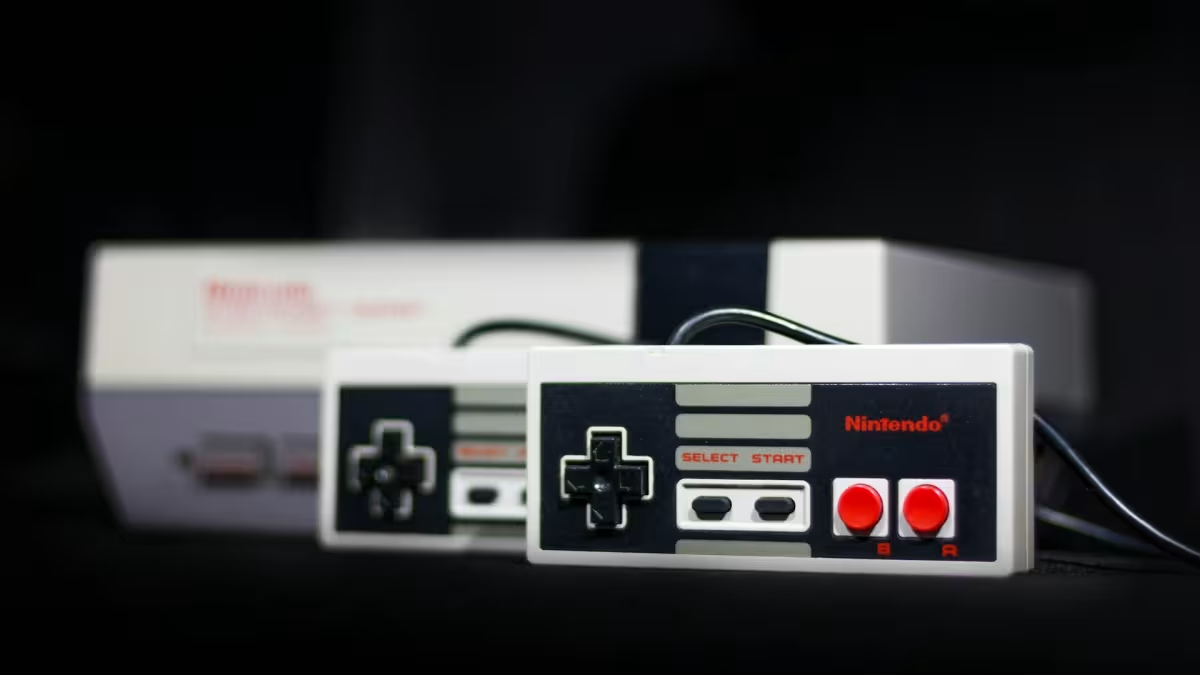
The earliest football games operated with brutal simplicity: your directional input was an exact instruction, nothing more. You could only pass to teammates positioned in specific spots relative to the ball, which meant precision passing was essentially impossible without fortune. In 1985, Konami released Soccer on both MSX and NES, introducing CPU-assisted passing that interpreted your vague directional input as a request to pass to the nearest teammate in that direction. By the mid-1990s, this became standard, and it fundamentally changed how soccer games felt in the hands.
Three-dimensional graphics arrived in 1994 via Virtua Striker, an arcade release that broke the mold entirely. The game featured polygonal players with shaky limbs and unusual proportions by modern standards, yet their detailed animations signaled the future. Within a year, both Konami and EA were investing in 3D technology, and the industry never pivoted back to two dimensions again.
The through ball became a hallmark of sophistication during Pro Evolution Soccer's peak years in the early 2000s. While FIFA dominated popularity, PES earned its reputation as the purist's choice largely because triangle button triggered through passes that felt incisive without being automatic. The timing and direction still mattered. Getting one right felt like genuine brilliance. EA struggled for years trying to engineer a comparable mechanic into its engine, but by the PS2 era both series had mastered it. In multiplayer matches, the lofted through ball to a sprinting striker became the dominant way to score.
FIFA 2003 introduced the Freestyle Control System, a skill stick that felt clunky and cumbersome at first. Over a decade of refinement, however, it evolved into an essential attacking weapon. Mapping tricks to the right stick made them faster and more intuitive than button combinations ever were. By FIFA 06, skill moves matched the natural motion of actual tricks: flick forward and sweep for a step-over, hold left or right for a ball roll. Today's elite players rely on skill moves to create space and fool defenders with a repertoire as complex as any fighting game.
Pro Evolution Soccer 5 introduced the controlled shot, enabling a whole new category of goals. Instead of simple power and aim adjustments, players could now curve finesse shots with precision: a winger cuts inside, aims for the far top corner, and watches the ball curve outside the post before swerving into the upper corner past a diving keeper. This mechanic became so central that virtually every football game since has included it, though refinements have added even more whip and control.
Ultimate Team arrived in March 2009 as paid DLC for FIFA 09 and transformed the business model of football gaming. The mode combined online multiplayer competition with card pack mechanics, building team chemistry through coin accumulation. FIFA 12 made it free at launch, signaling that EA viewed it as integral to the franchise. Today, for many players, EA FC is Ultimate Team, supported by an ecosystem of YouTubers, influencers, and professional players reacting to their in-game cards. The mode generates enormous revenue despite ongoing controversy around its gambling-like mechanics.
For decades, both FIFA and Pro Evolution Soccer restricted movement to eight cardinal directions despite advancing technology. FIFA 10 introduced 360-degree dribbling, finally unlocking seamless freedom of movement. Players could slip through tight spaces and change direction smoothly, creating a tangible sense of control that made returning to directional limitations unthinkable. Pro Evo attempted the same innovation that year with less successful results.
FIFA 12's tactical defending initially frustrated players accustomed to simpler systems, but it represented a genuine leap forward. Instead of a single button that pressured and tackled in sequence, the new system split these functions. One button contained the attacker while staying nearby, another initiated a tackle. This gave players granular control over aggression levels and rewarded patience and positioning. Defending became a true skill rather than a matter of button timing.
The most recent foundational shift arrived with EA FC 24's playstyles system. While FIFA had used traits to denote star player strengths for 15 years, playstyles became universally applied to every squad member. These boosted specific skills and granted unique animations: Press Proven players kept tighter control while jogging, Bruisers shoved opponents in tackles like bumper cars. Playstyles became so powerful that they now rival overall ratings in determining a player's usefulness, fundamentally changing how people evaluate squad composition.
Author Emily Chen: "The gap between how football games felt in 1985 and how they feel today is staggering, yet these nine features were the true hinges on which that transformation turned."
Comments