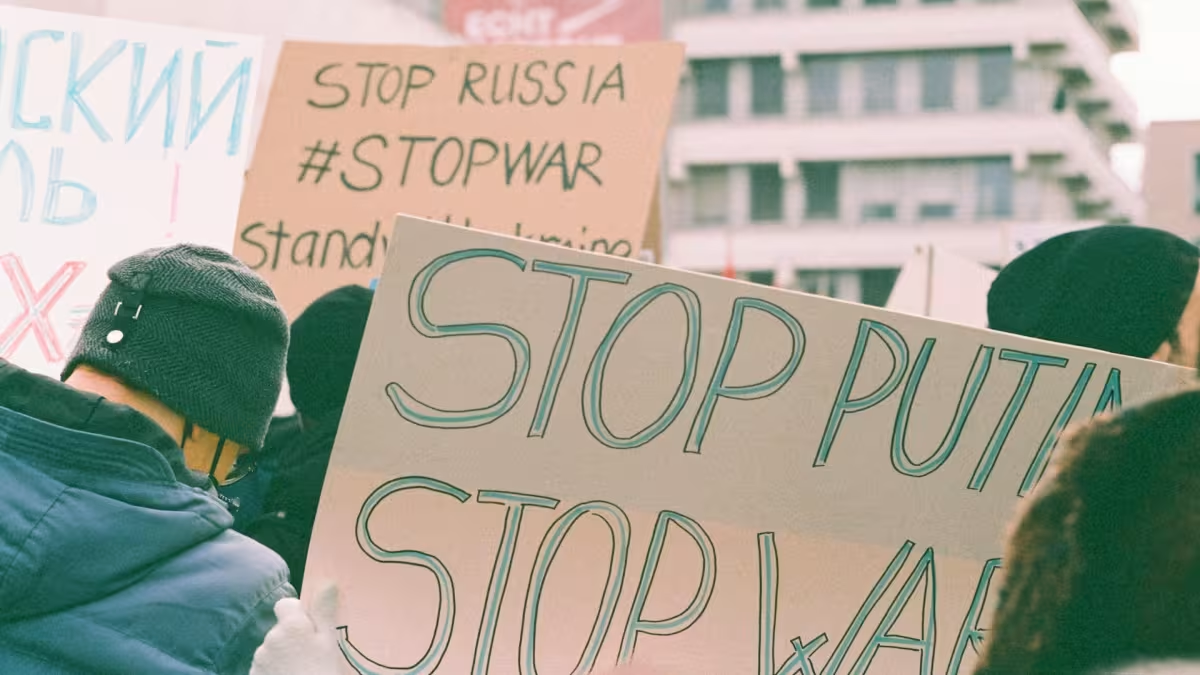
State police formed a human wall around a block near Delaney Hall in Newark, plastic riot shields locked together from helmet to knee. Inside the perimeter, known as a kettle, sat a few dozen people. Some were protesters who had defied a curfew order meant to suppress demonstrations at an ICE detention facility. Most were journalists trying to document what was happening.
An officer's helmet appeared above the shields as they parted. "Listen up," he commanded. "If you are press, you got the opportunity right now and that's it to leave. If you don't leave out here in an orderly fashion, you are coming with us." He pointed into the crowd. "You are not press."
Media workers had come to Delaney Hall to cover a hunger strike by ICE detainees protesting dangerous conditions inside the facility. As street demonstrations grew, police response created its own hazards. In a single week, the US Press Freedom Tracker documented 30 assaults by officers on journalists near the site. ICE personnel sprayed photographers with pepper spray and struck them with batons. State police ripped a WNBC crew from their vehicle, exposing them to tear gas. Newark police pushed Ali Velshi and his crew out of sight of the protest while he was broadcasting live on MSNBC.
The problem for police was simple: Under Newark's curfew order, journalists could be exempt if they displayed "verified credentials." But nothing about what counted as verified or who got to decide was written down. One independent photographer gained access only after submitting to a police pat-down and riding in the back of a police car.
Livestreamers and independent videographers increasingly cover protests that major newsrooms can't safely reach. While not on any television network payroll, many sell their footage to the world's largest news organizations. Whether someone works for a broadcaster or streams on TikTok, they are doing journalism.
On Sunday near Delaney Hall, five live video feeds showed what was unfolding inside the kettle. Not one came from a traditional TV camera.
State police released most press from the kettle and moved them about 100 feet away, a distance that posed no obstruction. But Newark police intervened and ordered journalists further down the street. From that vantage point, they could no longer see or hear what was happening. Journalists pushed back, understanding they were being denied the access necessary to do their job.
Just before the confrontation, protesters had chanted "press don't leave," hoping someone would witness their arrests. An officer keyed his radio to report that press refused to move further. A voice crackled back: "If they refuse to move, push them back yourselves."
At least three journalists remained trapped in the kettle. Each spent a full day in custody. Lawyers were denied access to see them. One was injured and taken to a hospital, where he saw two arrested protesters also receiving treatment. Without press cameras present, it was unclear how those detainees had been hurt.
Before being handcuffed, one of the arrested journalists wore a blue vest marked "press" with a company ID hanging around his neck. He was a member of the National Press Photographers Association. Officers told him his credentials were not verified. When asked what "verified" actually meant, neither the New Jersey governor's office nor Newark's mayor provided an answer.
Across the country, few police departments issue press passes anymore. Most abandoned the practice years ago, recognizing it handed government the power to decide who counts as a journalist. That's not a system that can coexist with a free press.
Officers do need to distinguish journalists from protesters. Courts have increasingly ruled that law enforcement should look for what they call "indicia" of press status. This includes police or employer-issued IDs, business cards, assignment letters, clothing labeled "press," or professional equipment. The approach isn't perfect, but it doesn't require officers to play gatekeeper.
Officials sometimes argue this standard makes verification harder. But the First Amendment wasn't designed to make an officer's job easier. Each time a cop swings a baton at a camera, law enforcement credibility takes another hit.
The indicia standard recognizes something fundamental: journalists aren't special because a central authority declares them so. Press rights exist to protect the act of informing the public, not to protect a chosen class of people. The authors of the Bill of Rights worked in a world of pamphlets and newspapers, independent publishers using the communication technology of their time. They would recognize today's independent streamers and Substack writers as doing the same work.
If an officer can point at someone and say they are not press, the First Amendment loses its meaning.
Author James Rodriguez: "Police don't get to decide who's a journalist, and every time they try, they prove why that power can't exist."
Comments