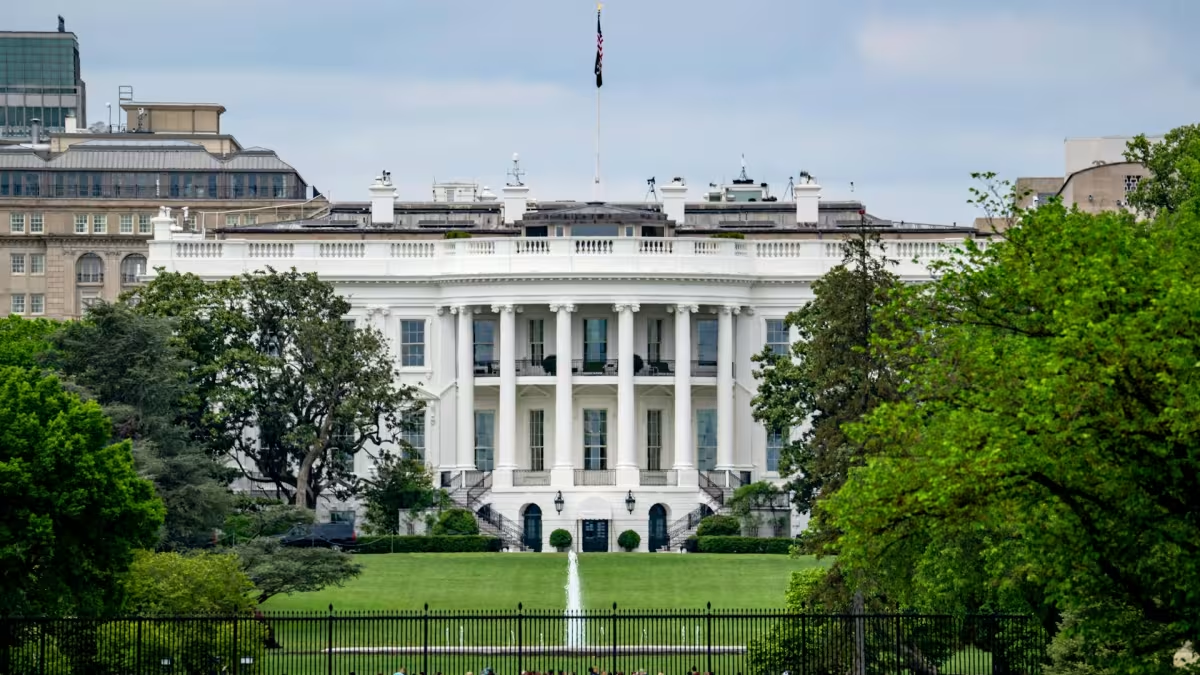
The Supreme Court's decision Thursday to shield Bayer from Roundup cancer lawsuits ignited fury within the Make America Healthy Again movement, with prominent activists accusing the Trump administration of sacrificing public health for corporate favor and warning that the ruling could cost Republicans crucial voter support.
The 7-2 ruling blocked state court litigation over whether the herbicide's active ingredient, glyphosate, causes cancer. The decision prevents thousands of potential lawsuits like the one brought by Missouri resident John Durnell, who won a jury verdict of 1.25 million dollars in 2023 after alleging that decades of Roundup use caused his non-Hodgkin lymphoma.
Vani Hari, the influential food activist known as "Food Babe," called the outcome "sickening" and flatly blamed the administration's intervention. "The decision is sickening and would have never happened had the administration not given Bayer Monsanto a favor," Hari texted. "Congress must act to remediate this."
The Trump administration had actively backed Bayer's petition in the case, a sharp reversal from the Biden administration's stance urging the Court to reject Bayer's appeal. The EPA, under Trump's first term in 2020, determined that glyphosate was unlikely to pose a cancer risk and required no warning label. That determination became the legal linchpin of the Court's majority opinion.
Kelly Ryerson, a prominent MAHA activist operating as "Glyphosate Girl," escalated the rhetoric on X, accusing the Trump team of a fundamental betrayal. "Never in history has an administration so blatantly and willingly sold out our fertility, vitality, and health to corporate interests," Ryerson wrote. "It is unforgivable. We will make sure all voters know exactly how this domestic chemical attack happened."
The rupture reflects broader tension between Trump and MAHA's core constituencies. In February, the president invoked the Defense Production Act to boost domestic glyphosate supply, a move that angered movement leaders despite Robert F. Kennedy Jr.'s public backing for the measure. Kennedy, now Health Secretary, has long claimed that glyphosate causes cancer and previously sued Monsanto as an attorney representing cancer plaintiffs.
MAHA activists have also criticized the FDA's expansion of fruit-flavored e-cigarette access in May, the EPA's rollback of mercury emissions standards, and moves to rescind drinking water limits for PFAS chemicals. The cumulative effect is eroding grassroots enthusiasm. Michaela Bardossas, a nutritionist affiliated with Moms Across America, told NBC News in April that MAHA supporters felt demotivated. "MAHA moms are not as motivated to vote at this point because we're not getting what we expected," Bardossas said. "The pesticide issue has been a huge slap in the face."
The Court's scientific foundation remains contested. The International Agency for Research on Cancer, part of the World Health Organization, classified glyphosate as "probably carcinogenic to humans" in 2015. In March, dozens of international scientists at a Seattle symposium concluded that glyphosate can cause cancer, with the strongest evidence pointing to non-Hodgkin lymphoma risk. Researchers have noted that the IARC analysis relied on peer-reviewed studies while the EPA drew from unpublished industry-funded research.
The EPA's 2020 determination faced legal challenge. A federal appeals court ruled that the agency had not adequately explained its analysis, and the EPA agreed to update its evaluation, though no new version has been published.
Two justices dissented. Ketanji Brown Jackson wrote that the majority's decision "unjustifiably closes the courthouse doors" to plaintiffs. Neil Gorsuch also dissented.
Congressional allies of MAHA are moving to exploit the opening. Representative Anna Paulina Luna, a Florida Republican, announced Thursday her intent to introduce legislation stripping pesticide companies of liability protections. "These companies purposefully omit labeling information knowing their products cause cancer and other health problems. It is time they are held accountable," Luna posted on X. Luna previously led a push to defeat farm bill language that would have protected Bayer from herbicide-related allegations.
Bayer issued a statement celebrating the ruling. "This decision is good for science, farmers, and industries that depend on regulatory clarity for innovation," the company said.
The White House declined to comment on the Supreme Court's decision. The Department of Health and Human Services did not respond to a request for comment on the ruling or its implications for Kennedy's health agenda.
Author Sarah Mitchell: "The Trump administration bet that shielding Bayer would go unnoticed by its base, but MAHA activists are neither silent nor forgiving, and this rupture could haunt Republicans in competitive races where suburban voters care most about health and chemical safety."
Comments