A Harvard epidemiologist's nearly $1 million research grant on discrimination and health vanished on a Friday afternoon with no warning. Nancy Krieger's three-year study was canceled mid-stream, leaving her scrambling to understand what had happened and scrambling to steady her team.
It was the opening shot in what has become a far broader assault. The Trump administration's Office of Management and Budget released a sweeping 400-page proposal in May that would fundamentally reshape federal grant-making and hand control of nearly $1 trillion in funding to political appointees by October.
The scale is staggering. The money funds not just research but healthcare, education, social services, and environmental protection across the entire federal apparatus. For context, the National Institutes of Health, the world's largest public funder of biomedical research, controls $47 billion. This proposal would touch everything.
Krieger has become one of the public faces of scientific resistance. She watched her colleagues suffer censorship, blunt exercises of power, and ideological gatekeeping. Now she finds herself at the vanguard of a united scientific community that spans from astronomers to marine biologists to public health researchers.
The OMB proposal would ban diversity, equity, and inclusion programs, prohibit what it calls "woke" research on gender and race, and give the government broad power to cancel grants no longer in its "interest." It would also discourage international scientific collaboration and allow the government to reject applicants based on vaguely defined "anti-American values."
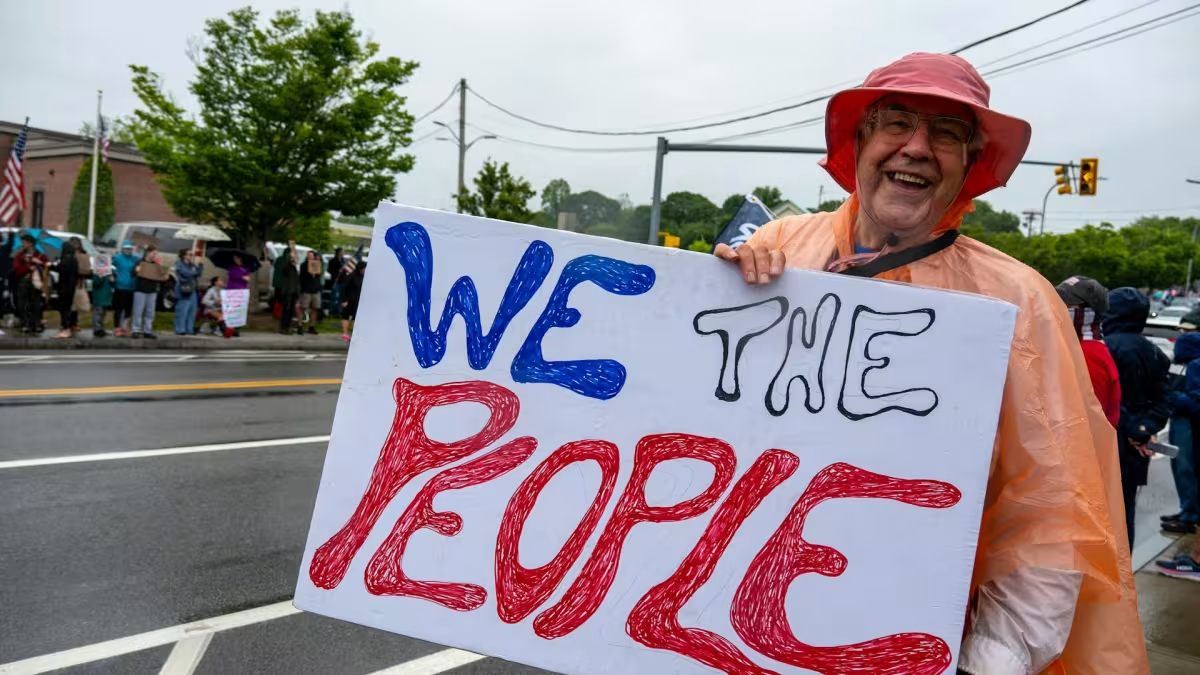
The pushback has been fierce and bipartisan. The rule attracted nearly 500,000 public comments, with roughly 95 percent opposing it. Twenty-two state attorneys general have aligned to challenge it legally. Democratic Senator Tammy Baldwin called it dangerous to public health. Republican and Democratic states alike see a fundamental threat to how American science works.
Sara Rosenbaum, a health policy expert at George Washington University, said the response should be straightforward. In normal circumstances, an administration facing half a million opposing comments would withdraw the rule. But she expressed low expectations that this administration would do the reasonable thing.
The administration compressed the public comment period to just 45 days, well below the typical 60 to 90 days for federal rule-making. Legal experts like Georgetown Law's Lawrence Gostin view this as a facade, suggesting the administration never intended to seriously consider the input.
The Heritage Foundation, which authored Project 2025, supports the proposal. The White House fraud taskforce called it necessary to stop taxpayer funding of "woke NGOs." OMB Director Russell Vought has characterized scientific opposition as a "freakout by those on the left."
If enacted, the fight will almost certainly move to federal court. But the path forward is murky. Gostin said a judge might need to see an actual grant denial before plaintiffs have legal standing to sue. Once that happens, state attorneys general and individual institutions would likely file suits. Whether those suits ultimately succeed remains uncertain, especially as appeals move through increasingly conservative appellate courts.
What is certain is the chaos already underway. Since Trump's second term began, federal funding disruptions have derailed clinical trials, halted long-term research projects, emptied laboratories, and ended early-career scientists' prospects. The proposal would institutionalize what has so far been ad hoc disruption.
Krieger and her peers understand what is at stake. The grants fund breakthrough medicines, pandemic preparedness, climate science, and knowledge that has no immediate commercial value but shapes how we understand the world. Handing that leverage to political appointees transforms federal funding from a meritocratic process into a tool of political control.
Author James Rodriguez: "This isn't about disagreement over research priorities, it's about whether politicians get to pick which scientists eat and which starve based on ideology."
Comments