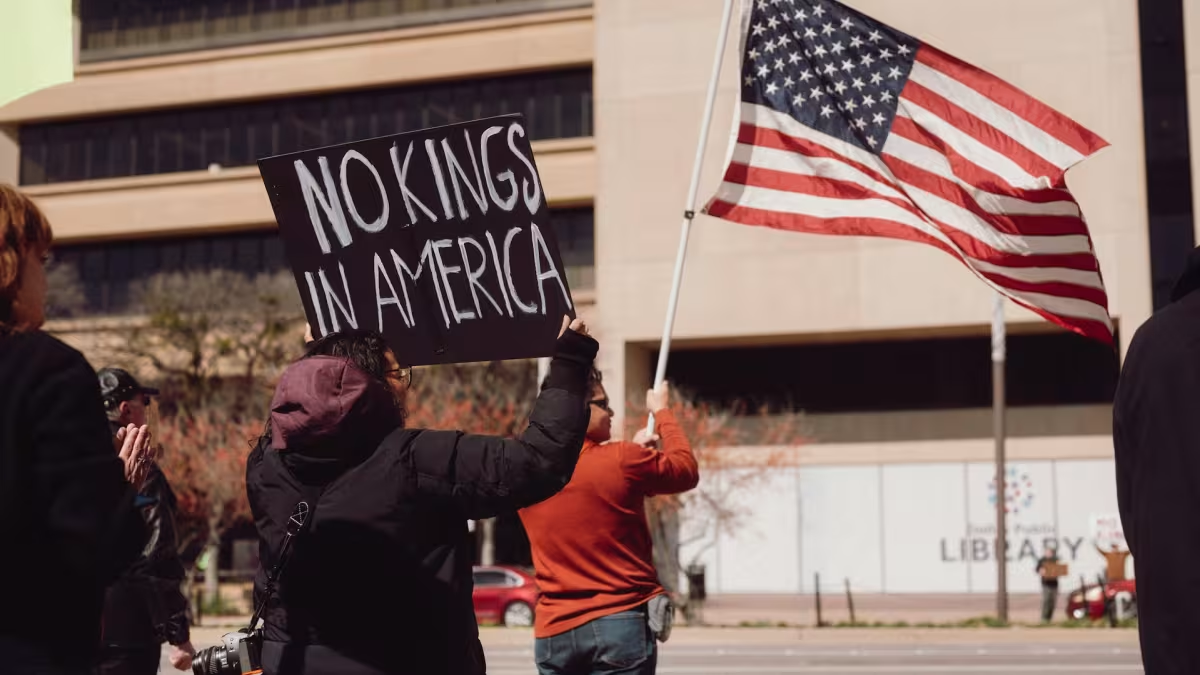
Federal prosecutors have indicted 15 Minneapolis residents on conspiracy charges stemming from their efforts to block and document Immigration and Customs Enforcement operations during a massive immigration enforcement surge earlier this year. The defendants, loosely organized through Direct Action MN, coordinated rapid response networks to alert residents to ICE activity and organized blockades at the city's ICE headquarters.
The charges mark the latest escalation in the Trump administration's legal campaign against protest movements. Similar conspiracy prosecutions have unfolded in Chicago, Spokane, and Texas, with wildly divergent outcomes. The Chicago case was dismissed due to prosecutorial misconduct, while Spokane defendants who formed a human barrier to block an ICE bus were convicted and face up to six years in prison. In Texas, eight protesters received sentences ranging from 30 to 100 years, with one convicted largely for possessing a printing press and distributing political materials.
The Minneapolis defendants say they will not be deterred. Musician and carpenter Emmett Doyle, who pleaded not guilty, performed an Irish protest ballad at a local bar days after his arraignment. "That song has been a source of inspiration for me, in finding courage to face this ordeal," he said. Treasure Thoreson, another defendant, rejected the government's intimidation strategy directly: "They're trying to stop us and silence us and scare us. I'm not going to let them scare me."
The 94-page indictment does not reference a single incident but rather the defendants' coordination across multiple actions. Prosecutors have labeled the group as affiliated with "antifa," a decentralized anti-fascist movement that the Trump administration designated a domestic terror organization in September. While the Minnesota 15 do not currently face terrorism charges, the indictment's language describing their actions as conducted through "force, intimidation, and threats" has raised concern among defense attorneys that prosecutors may pursue terrorism enhancements, which would substantially increase potential sentences.
Operation Metro Surge, which flooded the Twin Cities with nearly 4,000 immigration agents in January, triggered an unprecedented community response. Residents organized neighborhood watch networks to track ICE vehicles and alert neighbors, delivered food and essentials to people in hiding, and gathered at protests. Federal agents responded with forced home entries, vehicle searches, tear gas, and gunfire. Two residents monitoring ICE activity, Renee Good and Alex Pretti, were shot and killed by federal agents. No charges have been filed in those deaths.
The government's prosecutorial approach raises questions about proportionality. Kyle Wagner, one of the Minnesota 15 defendants, self-identifies as antifa, and prosecutors have used his association to apply the label to the entire group, according to Doyle. Legal experts note that conspiracy law requires little more than an agreement to commit a crime, making it a powerful prosecutorial tool.
Attorney Sufia Khalid pointed to a stark contrast in enforcement: the same conspiracy and material support theories prosecutors deployed in Texas could have applied to thousands of January 6 Capitol protesters, yet were not. "The same theory that they used to apply that enhancement in Prairieland, they could have used for all 1,500 of the January 6 protesters," Khalid said. "They did not."
Several factors may work in the Minneapolis defendants' favor. The case will be tried in a federal district shaped by sustained protest over police violence and the aftermath of George Floyd's murder, making it harder for prosecutors to find a jury receptive to the government's case. Additionally, unlike the Texas prosecution, the Minnesota charges carry lower maximum sentences of six years for the principal conspiracy count, and no violence was committed. Attorney Jordan Kushner emphasized that distinction: "There was no violence committed. No one was hurt."
The government's surveillance capabilities loom large. Prosecutors have amassed 15 to 16 terabytes of encrypted Signal messages, which have not been disclosed to the defense. Organizers warn that encrypted apps should be treated as potentially monitored. The broader surveillance toolkit available to federal agents now includes geofencing, facial recognition, drones, and digital forensics, raising concerns about investigative overreach.
Despite the legal jeopardy, Minneapolis organizers say they will continue their work. The death of Good and Pretti has not silenced them. "It was always something you could get killed doing," said Jonathan, an organizer who requested anonymity. "They shot someone, and then I still went and [protested]." Kelly Peterson, another organizer, highlighted the ordinary nature of the defendants: "These are teachers and nurses and electricians. They just have to keep going to work, knowing that they did what 100,000 other people did, and that they got charged for it."
Doyle framed the prosecution differently than simple retaliation. "I don't see our case as Trump's revenge for the resistance during Metro Surge," he said. "I see it more as the government attempting to break the resistance so that they can come back and do another round of spectacular violence in our community and claim victory." He added, "But the resistance here was leaderless. It was mass resistance. My community's not going to be intimidated."
Author James Rodriguez: "This case crystallizes how protest movements now operate in a legal minefield where the government weaponizes conspiracy law to criminalize coordination itself, not violence."
Comments