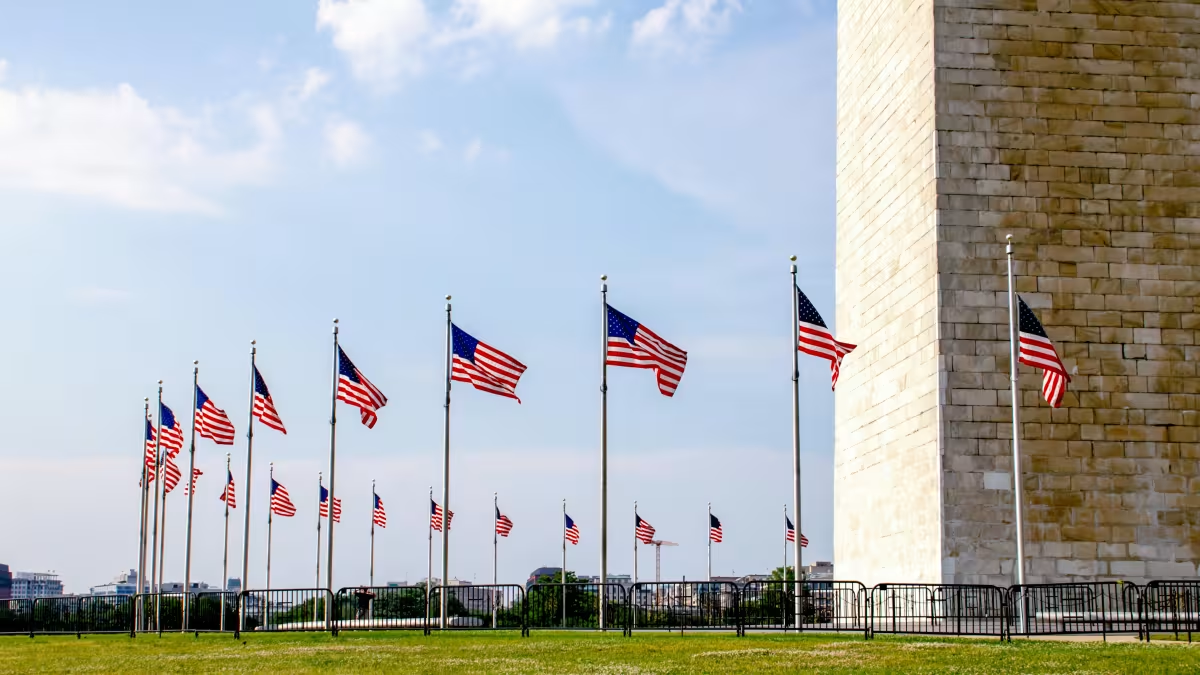
As the nation approaches its 250th birthday, the American flag no longer commands uniform reverence. Some citizens are flying it upside down to signal distress. Others have replaced it with state flags or Pride banners. Still others display it reluctantly, worried neighbors will misinterpret the gesture as political endorsement.
The symbol that once united has become a flashpoint of division, pulled in competing directions by Americans who see the same cloth through radically different lenses.
Bruce Watson, a writer in a small New England town, has been a flag advocate for years, regularly urging neighbors to display their colors. But now he worries the Stars and Stripes carries unwanted baggage. "If we do fly the flag, we will also put out signs to make it clear that we are not MAGA," he said at 72 years old.
The shift reflects deeper fractures in how Americans view patriotism and national pride. NBC News asked readers about their flag practices and discovered a nation at odds with itself over one of its most recognizable symbols.
Dina Bannick, 61, who lives outside Des Moines, Iowa, now flies her flag upside down as a distress signal. "Donald Trump has turned everything upside down, so it makes sense our flag should be upside down," she said. "It's a shame. We used to be a proud nation. Now, our country is in distress."
That practice draws sharp rebuke from Trump supporters. Dave Cavannah, 49, a professional woodcarver from Monson, Massachusetts, who is currently chiseling a Trump statue on his front lawn, sees upside-down flags as an insult to the nation itself. "I couldn't be prouder to be an American," he said. "I believe Americans should be proud to fly the flag and fly it the right way. What's shameful is that people who hate Trump are flying the flag upside down."
Yet flipping the flag is not new territory. Trump supporters themselves flew it upside down after his 2020 election defeat, and the image was recorded outside conservative Supreme Court Justice Samuel Alito's Virginia home in January 2021, the same month pro-Trump rioters stormed the Capitol.
Some Americans have abandoned Old Glory altogether in favor of alternatives. Master Sgt. Frank Chappell of the Air National Guard's 171st Air Refueling Wing, stationed outside Pittsburgh, replaced his U.S. flag with Pennsylvania's state flag. "Part of what makes us Americans is that we can meet in the middle, we can come together in the center and find things we can all agree on," Chappell said. "But what Trump has been doing, through some of his rhetoric and policies, is driving a wedge between Americans, dividing us even further." He said he will return to flying the national flag once he believes "the states are more united in vision, tolerance and empathy toward our fellow Americans."
A Rhode Island teacher, speaking anonymously to protect her family, has flown the Pride flag and her New England Patriots banner instead since Trump's 2024 election victory. "I have a gay son and a trans son and felt that that flag was now a symbol flown by people who don't want my children to exist," she said. Erin Beltle, 22, living outside Philadelphia, said her father still flies the American flag but she and her mother prefer the Pride flag or Philadelphia Eagles colors.
Not all hesitation stems from conviction. A woman in Newtown, Pennsylvania, displayed her flag mainly because neighbors did, despite her own ambivalence about the country. "I feel that if I don't have a flag displayed somewhere, people will think I'm against our country or something," she said.
Yet some Americans fly their flag as an act of stubborn patriotism that transcends politics. Rebecca Dyer, a mother of five outside Salt Lake City, continues raising the colors regardless of who holds office. "I just want to say I love our flag, I love our country and I want people to realize this is not about one party or one person," said Dyer, 38. "Yes, the last few years have been hard, and sometimes it feels like our flag has been taken over. But I'm flying the flag because I'm still proud of our country, even if it's not where I think it should be 250 years after it was founded."
A Centuries-Old Battle
The tussle over ownership of the flag runs deep into American history. Until the mid- to late-19th century, flags were displayed chiefly on government buildings. It was only after the Civil War and the 1876 centennial that private citizens began flying them regularly.
The symbolic warfare intensified during the Vietnam War, when both liberals and conservatives claimed the flag to support opposing positions on the conflict. The left used it to argue against a war that violated American principles of self-determination. The right wielded it to suggest that patriotism meant unconditional support for the nation's actions.
Historians say the hard right "seized the flag" and used it to paint liberals as unpatriotic. Sean Wilentz, a historian at Princeton University, noted that "conservative and right-wing politicians went along with this, exploited it, and the dialectic of disaffection worsened." Trump, he added, has amplified that particular brand of patriotism.
Yet flag sales tell a different story about national sentiment. Despite apparent declining pride, flagmakers have experienced a surge. Carter Beard, president of New Jersey-based Annin Flagmakers, a sixth-generation firm that has sewn flags for events ranging from Abraham Lincoln's funeral to the Apollo moon landing, reported business up roughly 20 percent this year. "Not like 50%, but in the 20% range. This being the anniversary, we're definitely seeing a surge of patriotism with people wanting to fly the flag," he said.
Alex Wagner, an adjunct professor at Syracuse University's Maxwell School, argues that Americans should embrace the Stars and Stripes as a shared inheritance. "Our flag is ever-evolving, like our country," he said. "The United States has evolved from 13 colonies to the 50-state union that it is now, and the flag has changed along with it. It's not MAGA's flag. It's not Trump's flag. It's the American flag, and it belongs to all of us."
Author Sarah Mitchell: "The flag's crisis isn't about cloth and dye, it's about whether Americans can stop treating patriotism as partisan property."
Comments