Barbara McQuade, a former federal prosecutor and University of Michigan Law School professor, has written a book that draws explicit parallels between Donald Trump's approach to power and the methods of organized crime syndicates, specifically invoking the fictional Don Corleone as her template for understanding the president's relationship with loyalty, favors, and control.
The comparison begins with a scene from The Godfather. When Vito Corleone agrees to help Amerigo Bonasera, a funeral director seeking revenge for violence against his daughter, he does so with a condition embedded in courteous language: "Someday, and that day may never come, I'll call upon you to do a service for me." McQuade interprets this as a demand for fealty masquerading as generosity. "What he's saying is I'm going to do this thing for you but now you're beholden to me," she explains. Transposing the model onto the Trump presidency, McQuade contends that every favor the president extends comes with an invisible price tag. "Every time he does somebody a favor, whether it's an appointment or something else, he expects there to be a quid pro quo."
McQuade's book, titled The Fix: Saving America from the Corruption of a Mob-Style Government, documents what she views as a systematic erosion of democratic norms through mechanisms borrowed from criminal networks. Her prosecutorial experience gives the argument weight. From 2010 to 2017, she served as US attorney for the eastern district of Michigan, overseeing high-profile cases including that of former Detroit Mayor Kwame Kilpatrick and the conviction of Umar Farouk Abdulmutallab, the so-called underwear bomber.
In her analysis, Trump uses both incentive and intimidation to secure compliance. Examples she cites include the president's pardons for January 6 rioters and political donors, his acceptance of a $400 million aircraft from Qatar, and his cultivation of relationships with tech billionaires in exchange for favorable regulatory treatment. These actions, McQuade argues, violate the constitutional emoluments clause, yet they illustrate the transactional nature of Trump's interactions with power brokers.
The leverage extends into business. McQuade points to Trump's threat to delay the opening of the Gordie Howe bridge between Detroit and Canada, a delay that coincided with a million-dollar donation to a pro-Trump Super PAC by the owner of an adjacent private bridge. The pattern, she contends, reveals a president who weaponizes federal authority to bend others to his will.
McQuade traces the roots of Trump's approach to Roy Cohn, the notorious lawyer who represented Trump and his father during a 1970s Justice Department lawsuit alleging racial discrimination in their rental practices. Cohn, who had worked as an assistant US attorney and counsel during Senator Joseph McCarthy's red scare investigations, taught Trump a survival strategy: fight back always, admit nothing, and turn accusations back on accusers. "He showed Trump the way to deal with being charged or attacked is to always fight back, to never admit to anything, to always turn the tables and accuse your accusers and we see him do that to great success," McQuade says.
During Trump's first term, she argues, traditional government officials acted as moderating forces against his impulses. His second term, by contrast, is built on a different foundation. Rather than seeking competence and expertise, Trump has populated his administration with loyalists. McQuade cites the appointment of Robert Kennedy Jr., a vaccine skeptic, to lead the Department of Health and Human Services and Pete Hegseth, a former Fox News host with minimal senior leadership experience, as Pentagon chief during an era of global military tension. The principle underlying these choices is explicit, even if unspoken: you owe your position to me.
McQuade illustrates this through the story of former FBI Director James Comey, who recalled Trump inviting him to dinner and saying, "I expect loyalty." That expectation violated fundamental principles of how the Justice Department functions, yet it became Trump's operating standard. When Trump pardoned Texas Congressman Henry Cuellar, indicted on corruption and money laundering charges, the president later erupted in fury upon learning that Cuellar still intended to run for re-election as a Democrat. McQuade's interpretation was blunt: "If I do something for you, you are now beholden to me. I control you. I own you."
The stick deployed alongside the carrot proves equally coercive. Trump issued executive orders targeting elite law firms that had previously employed attorneys who investigated him, including Robert Mueller and Andrew Weissmann. These firms lost security clearances and access to federal courthouses. Rather than resist, McQuade notes, most succumbed, prioritizing business continuity over legal principle. Once paid off, however, the extortionist returns for more. These law firms found themselves sidelined from challenging any Trump executive orders or policy initiatives. "Trump has bought silence from his most stringent challengers and critics," McQuade observes.
She extends this analysis to media companies, noting CBS's settlement of a baseless consumer fraud lawsuit Trump filed over standard editing in a 60 Minutes interview with Kamala Harris. The settlement, McQuade argues, reflects corporate priorities centered on federal approval of mergers over journalistic ethics. Yet some outlets have resisted. The Associated Press refused to rename the Gulf of Mexico. The Wall Street Journal defied threats to suppress a Trump birthday note to Jeffrey Epstein. These holdouts, McQuade contends, will be remembered as the heroes of the era.
The judiciary presents a mixed picture. Lower court judges across party lines have largely blocked the administration's most egregious overreaches. The Supreme Court, however, concerns McQuade less because she believes the conservative justices are "in Trump's pocket" than because their ideological commitment to the unitary executive theory, which grants the president sole authority over the executive branch, has arrived at a dangerously inopportune moment.
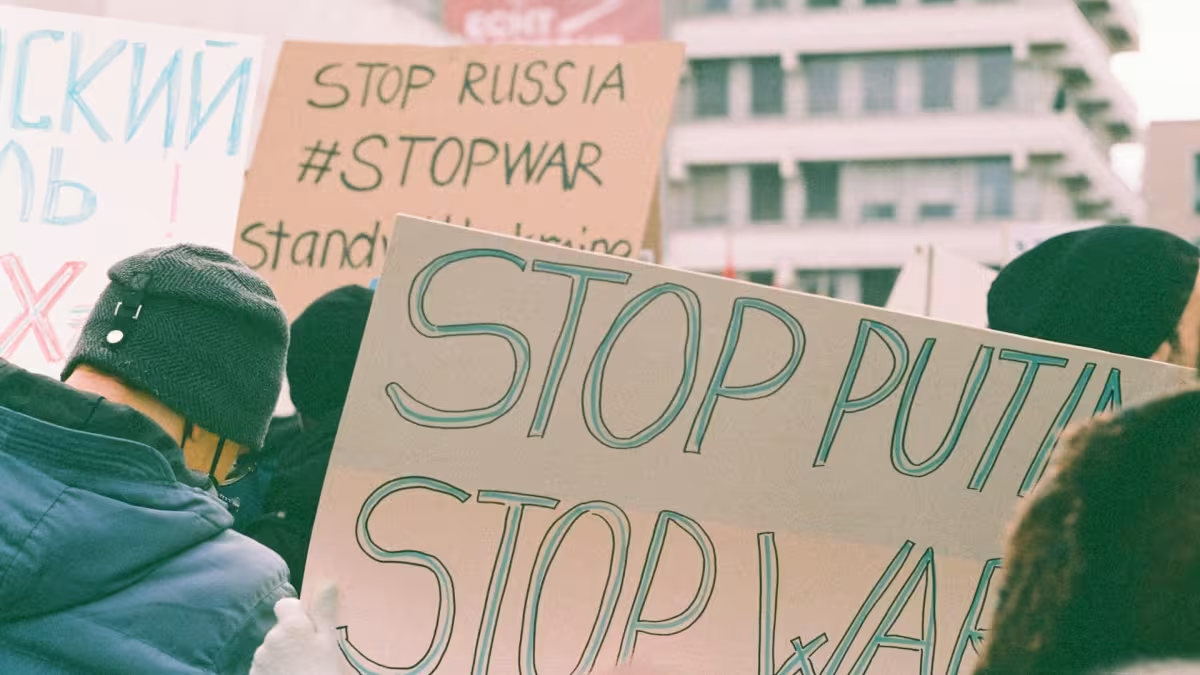
McQuade's book does not end in despair. She draws on research by Harvard political scientist Erica Chenoweth showing that when just 3.5 percent of a population engages in sustained peaceful protest, they can bring down authoritarian governments. McQuade advocates for Americans to run for local office, work on campaigns, and join grassroots organizations to combat election disinformation. She argues that the political opposition must build alliances between progressives and rural populists rather than retreat into partisan corners, focusing on shared concerns like affordability, housing, and jobs.
Ultimately, McQuade believes the authoritarian system will collapse as voters confront the inability of Trump's governance to deliver on its promises amid rising gas prices and foreign complications. "We have the power to fix what's wrong with us," she concludes. "We the people have the power to take back our democracy."
Author James Rodriguez: "McQuade's mob-state analogy is sharp and her prosecutorial eye catches patterns most political analysts miss, but the real power of her argument lies not in the comparison itself but in her insistence that ordinary citizens still have agency to push back."
Comments