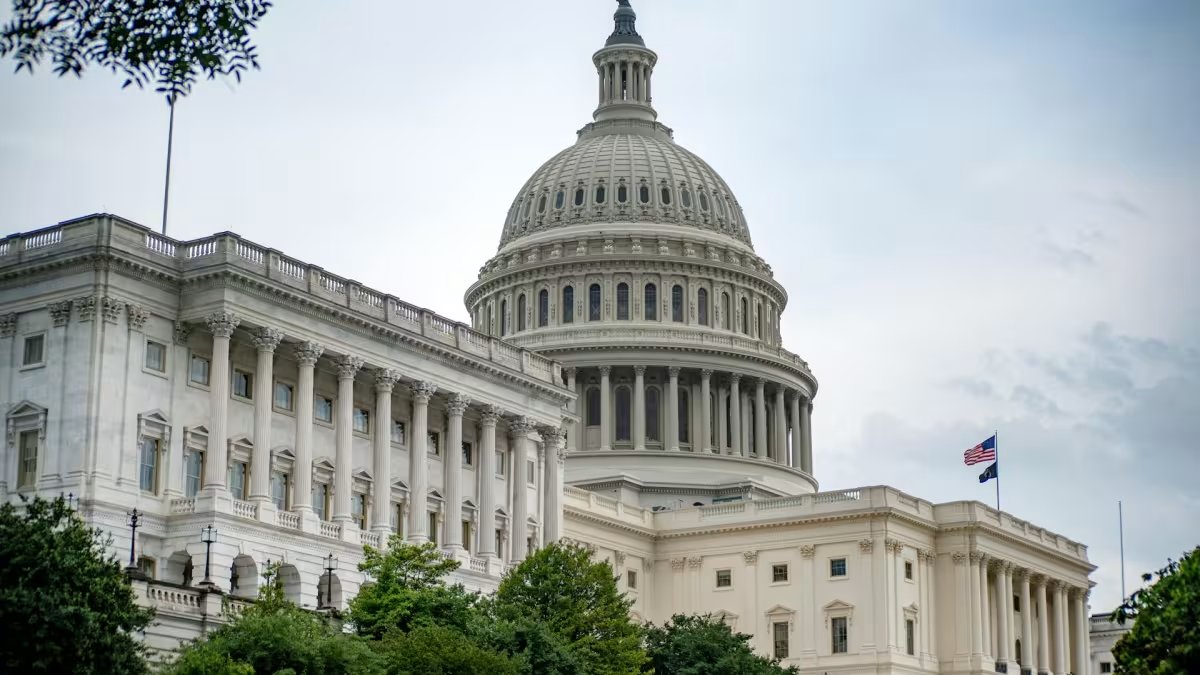
A cornerstone surveillance power is set to lapse Friday after House Republicans abandoned efforts to extend it and left Washington for nearly two weeks, marking the first time Congress has allowed Section 702 of the Foreign Intelligence Surveillance Act to expire since the provision became law in 2008.
Section 702 grants the government broad authority to monitor foreign nationals overseas without a warrant as part of counterterrorism operations. But the real drama unfolding in Congress stems not from disagreement over the tool itself, but from President Trump's move to install Bill Pulte, a housing official with no intelligence background, as acting director of national intelligence.
The appointment proved toxic enough to collapse delicate negotiations. Democrats signaled they would block any FISA renewal if Pulte assumed the role, with Senate Minority Leader Chuck Schumer declaring the situation untenable. "Pulte's got to go. The DNI role is too important. He cannot be there, no ands, ifs or buts," Schumer said.
Thursday's vote for a short-term extension through July 2 crashed badly. The measure drew 198 votes in favor but needed 289 to pass under the fast-track process, falling 91 votes short. Nineteen Republicans crossed over to vote against the extension alongside 199 Democrats, while just seven Democrats supported it. With no hope of advancing the bill, House Speaker Mike Johnson adjourned the chamber until June 23.
Johnson blamed Democrats for playing politics with national security, but the Republican miscalculation had clearly backfired. Pulte, known for targeting Trump critics through mortgage fraud investigations, alarmed Democrats and some Republicans alike. Intelligence Committee Democrat Jim Himes acknowledged that Trump's subsequent announcement of Jay Clayton, a well-respected former SEC chairman and federal judge, might have changed the entire trajectory. "Had this nomination been made a week ago, lots of pain might have been avoided," Himes said.
But Clayton still needs Senate confirmation, and Trump plans to install Pulte in the role temporarily in the interim. This fact alone kept Democrats from budging.
The political calculation diverges sharply on the operational impact. Some lawmakers, including retiring centrist Republican Don Bacon, described a lapsed Section 702 as catastrophic. "Fifty percent of our intelligence comes from FISA," Bacon said, arguing the tool has prevented terrorist attacks that would have killed Americans.
Senator Ron Wyden, a longtime privacy advocate, offered a different perspective. According to a Brennan Center for Justice analysis his office cited, existing court certifications approved in March will remain valid through next March even if the statute sunsets. The report noted that communications companies would still face legal obligations to comply with directives to turn over target data. "Congress planned for potential lapses and made very clear that Section 702 surveillance may continue under existing certifications even if the statute sunsets," the report stated.
Wyden has long insisted that any renewal must include stronger warrant requirements and restrictions on location tracking. "The path to 60 votes, which is the ultimate objective here, is tied to reforms," he told reporters.
Senator Mark Warner, a Democrat, characterized Pulte as a "huge national security risk," citing his handling of confidential mortgage industry information. "Now we're going to give him the keys to the intelligence agencies? It's crazy," Warner said.
The standoff reveals the fragile state of surveillance law at a moment when both parties claim to champion security. What began as a genuine debate over privacy guardrails transformed into a personnel crisis that neither side appears willing to resolve quickly. Republicans face pressure from Trump, while Democrats refuse to grant the incoming administration control of the intelligence community without assurances about who will hold that power.
Bacon's suggestion was direct: Trump needs to distance Pulte from the DNI office and nominate someone with actual intelligence experience if he wants FISA renewed. Whether Trump will do so before the lapse takes effect remains unclear.
Author Sarah Mitchell: "This collapse wasn't about surveillance policy at all, it was about Trump's tin ear for the politics of his own party and how quickly his personnel choices can blow up legislative agendas."
Comments