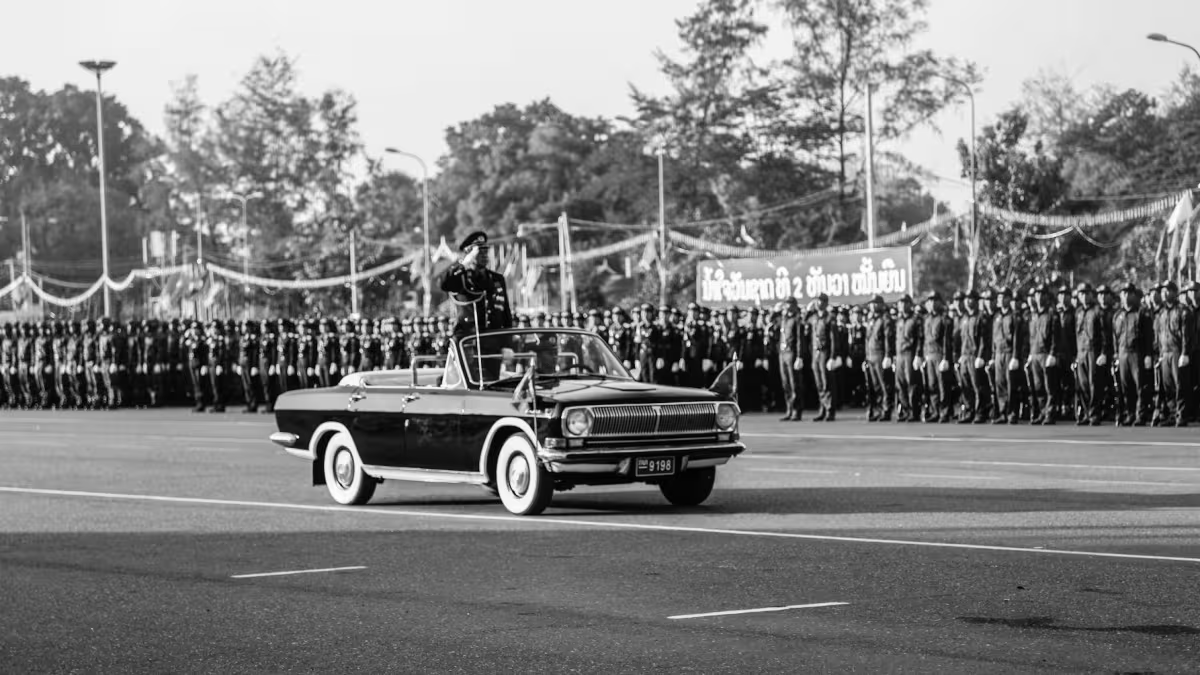
Two strongmen, two unwinnable conflicts, one shared delusion. Vladimir Putin's grinding campaign in Ukraine and Donald Trump's military posturing toward Iran reveal a common authoritarian pathology: leaders who cannot admit strategic failure because their entire identity rests on infallibility.
The wars themselves are fundamentally different. Russia's effort to crush a neighboring democracy has proven far bloodier and more sustained than any American military venture. Putin launched what he promised would be a swift operation to capture Kyiv weeks ago. Instead, his forces have spent years grinding down eastern Ukraine while absorbing staggering losses. The Nazi invasion of the Soviet Union lasted shorter than this "special military operation." Russian soldiers and treasure have been sacrificed not for territorial gain but for a leader's mythologized vision of national restoration.
The human cost has become impossible to hide. Residents hundreds of miles from combat zones see the black plumes from oil refineries struck by Ukrainian drones. They watch their wages devoured by inflation. They noticed how Russia's Victory Day parade, the crown jewel of military pageantry, became a muted affair last month because Ukrainian aircraft could threaten Red Square itself. Official polling shows erosion in Putin's support, though state-controlled data agencies quickly "corrected" the numbers. The slip revealed factional tensions within the Kremlin between pragmatists warning that the security hardliners' approach is failing and ideologues demanding continuation.
But Putin cannot reverse course. He has cast the conflict as an existential battle to reclaim national honor against a treacherous West, positioning himself as the embodiment of Russian destiny entitled to dominate neighboring territories. Negotiating with Volodymyr Zelenskyy as an equal president of an independent nation is incompatible with that mythology.
Trump operates from a different playbook but arrives at the same trap. Where Putin is burdened by centuries of imperial nostalgia, Trump is propelled by celebrity narcissism and a conviction that alpha powers deserve dominion over lesser nations. He was readily convinced that Ukraine's resistance was hopeless and that Putin held all the cards, a conclusion that would have required acknowledging that someone in Zelenskyy's league could actually prevail. Such an admission would wound his own sense of supremacy.
Had Trump engaged with facts on the ground, he might have noticed how drones have inverted traditional military advantage, allowing smaller forces to devastate overwhelmingly larger ones. That lesson could have informed his calculations about Iran. Military analysts at the State Department and CIA have gamed an all-out campaign against the Islamic Republic. Their conclusion: regime change cannot be achieved from the air, and Iran can retaliate by closing the Strait of Hormuz with catastrophic economic consequences.
Understanding these constraints would require Trump to accept limits on American power, which is psychologically equivalent to accepting limits on his own potency. Intolerable. Like Putin, he is surrounded by advisers too frightened or ideologically committed to draw him a map back to reality.
The two leaders' predicaments feed each other in unexpected ways. A Trump administration consumed by Iran negotiations has little capacity for Ukraine. That tilts the calculus against Putin's bet that Washington can bully Zelenskyy into territorial concessions. It also opens space for Europe to act. Hungary's Victor Orban, long Putin's favored disruptor within the European Union, lost his recent election. The removal of that obstacle unblocked aid to Kyiv. European capitals are now seriously discussing peace initiatives and negotiating frameworks, a shift unimaginable when Orban could veto consensus.
This week Keir Starmer convened Zelenskyy alongside Germany's Friedrich Merz and France's Emmanuel Macron at Downing Street. Such gatherings paper over genuine gaps between what Ukraine militarily requires and what Europe is prepared to supply. Uncertainty remains about what a Europe-led coalition would actually commit without American backing. Yet Putin's confidence that decadent Western powers lack the stamina to resist Russian barbarism has gone unvalidated.
Both Putin and Trump, along with their movements, share contempt for Europe as a civilization in cultural collapse from immigration and liberal excess. Nationalists across the continent echo this diagnosis, often amplified by influence operations originating in Moscow and the American far right.
This underestimates liberal democracy's core strength: the resilience of pluralism and institutional tolerance for opposition. The authoritarian sees dissent as betrayal and builds a system that prioritizes loyalty over truth, eventually banishing reality itself from the room.
The United States still possesses constitutional guardrails, fair elections, independent courts, and a free press to correct this trajectory. Russia does not. European democracies must now prove their system is not merely superior in theory but stronger in practice. The path forward runs through embrace of Ukraine's struggle as their own existential matter.
Author James Rodriguez: "Both men are learning that reality doesn't negotiate, but their pride won't let them accept the bill."
Comments