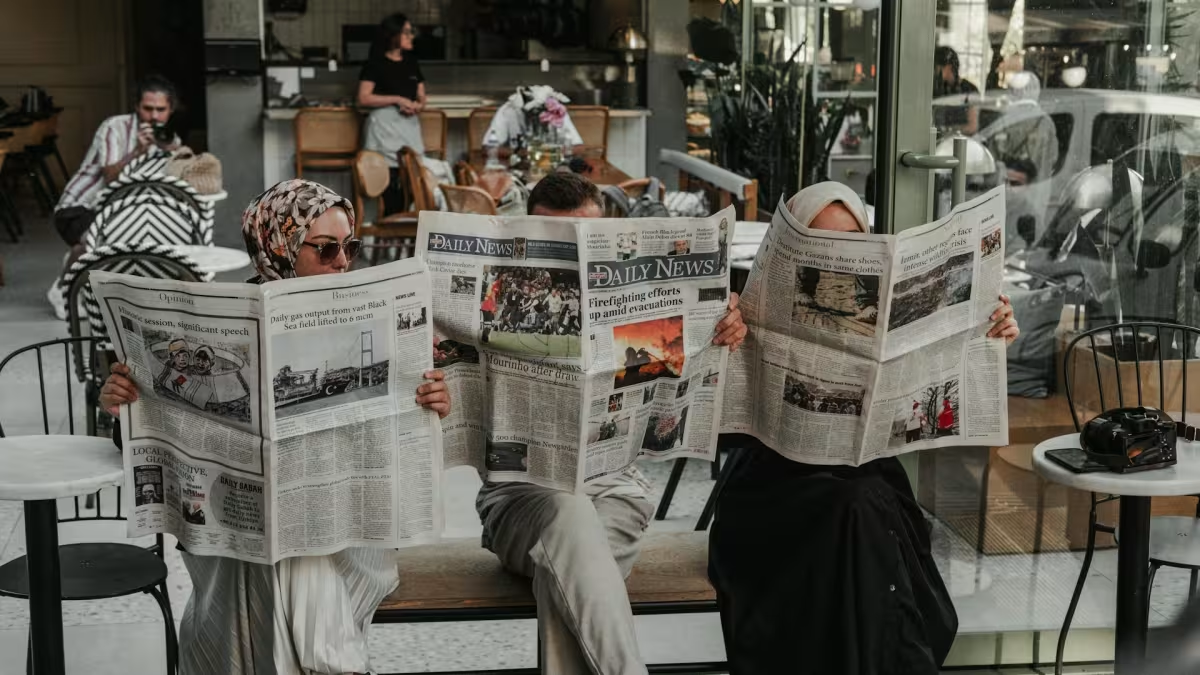
Arsenal's drought is over. After 22 years without a Premier League title, the North London club finally reclaimed the crown, sending jubilant supporters flooding outside Emirates Stadium in celebration. The championship represents one of sport's sweetest redemptions, ending a generation-long wait that had tested the patience of the club's faithful.
The sporting triumph came as the world grappled with far graver concerns. In the Democratic Republic of Congo, an Ebola outbreak spiraled into crisis mode. The World Health Organization revised its threat assessment upward to "very high" on Friday, revealing the scale of the epidemic had nearly tripled in just one week. Almost 750 suspected cases and 177 deaths were reported, a stark jump from the 246 cases and 65 deaths documented when the outbreak first emerged. Medical staff in Rwampara worked amid the chaos, escorting bodies and treating patients as the virus spread with alarming speed. The crisis extended beyond Congo's borders, with a US doctor who had contact with infected individuals in Uganda arriving at a hospital in Prague for evaluation.
Halfway around the world, Vladimir Putin touched down in Beijing for a state visit that underscored deepening ties between Moscow and China. Chinese President Xi Jinping and Putin issued a joint statement condemning what they characterized as "irresponsible" US foreign policy, warning of "a drift back to the law of the jungle." The show of unity came as members of the Chinese People's Liberation Army honour guards marched through a welcome ceremony at the Great Hall of the People.
Gaza remained caught in a grim holding pattern more than seven months after Donald Trump brokered a ceasefire. Despite the pause in fighting, no reconstruction effort had begun. The so-called Board of Peace struggled with funding shortages, and Palestinian technocrats selected to administer the strip found themselves sidelined in Egypt. Among the civilian population, hardship deepened. Brides turned to used wedding dresses as new gowns became unaffordable due to war-driven shortages and inflation. At a clinic run by Médecins Sans Frontières, technicians crafted 3D-printed transparent face masks to treat burn victims. The violence itself continued to exact a price: a funeral procession in Gaza City bore the bodies of Izz al-Din al-Haddad, chief of the Qassam Brigades, along with his wife and daughter, all killed in an overnight Israeli strike.
On the West Bank, Israel's far-right finance minister Bezalel Smotrich ordered the evacuation of Khan al-Ahmar, a Bedouin village, as part of measures targeting the Palestinian Authority. A child in the village rode a donkey through streets now shadowed by that threat.
International outcry over Gaza intensified when activists detained aboard an aid flotilla were released after Israeli interception. Organizers alleged that those freed had suffered abuse, with several hospitalized from injuries and at least 15 reporting sexual assaults, including rape. In Athens, protesters hung a massive Palestinian flag on a building facing the Israeli embassy in response to the flotilla incident.
Closer to home for many readers, Southern California burned. The Sandy fire in Simi Valley forced more than 17,000 people to evacuate as flames threatened suburban neighborhoods. Fire crews worked to control the blaze while residents watched charred hillsides replace once-green terrain.
In Bolivia, demonstrations turned confrontational. Police clashed with protesters clearing roadblocks in Achica Arriba, prompting center-right President Rodrigo Paz Pereira to announce a cabinet reshuffle. He declared he would not "dialogue with vandals" but pledged to establish a council allowing Indigenous groups, farmers, miners and other workers to participate in decision-making.
Kenya's transport sector ground to a halt over rising fuel prices, part of a broader African vulnerability to energy costs. The nation, like many on the continent, depends heavily on Gulf fuel imports and has been hit hard by Iran's effective closure of the Strait of Hormuz.
Political protests erupted elsewhere in Europe as well. In London, British anti-immigration activist Stephen Yaxley-Lennon organized a "unite the kingdom" rally that fell well short of expectations. Police assessed the crowd at less than half the size of a similar event held the previous year, undercutting organizers' ambitions.
In Nantes, France, football ultras brought their own kind of chaos. Supporters of the local club stormed the pitch during a match against Toulouse, throwing black flares and forcing the match to be abandoned after just 22 minutes. The club's owners stayed away due to safety concerns that proved prescient.
Elsewhere, life carried on in quieter moments. South Korean Buddhists celebrated the Lotus Lantern festival marking Buddha Era 2570. In Lagos, a worker arranged hair extensions in a workshop. In Tehran, couples participated in a mass wedding ceremony organized by the Islamic Revolutionary Guard, where "self-sacrificing" refers to those prepared to defend the Islamic Republic if called upon.
At Arlington National Cemetery, Army Sergeant Kosovare Fain carried her daughter Reagan during the annual Flags-In ceremony, a moment of civilian life meeting solemn military tradition.
Author James Rodriguez: "Arsenal's title feels almost quaint against a week where Ebola surges, Gaza limps through ceasefire, and the globe lurches from football pitch violence to presidential pomp."
Comments