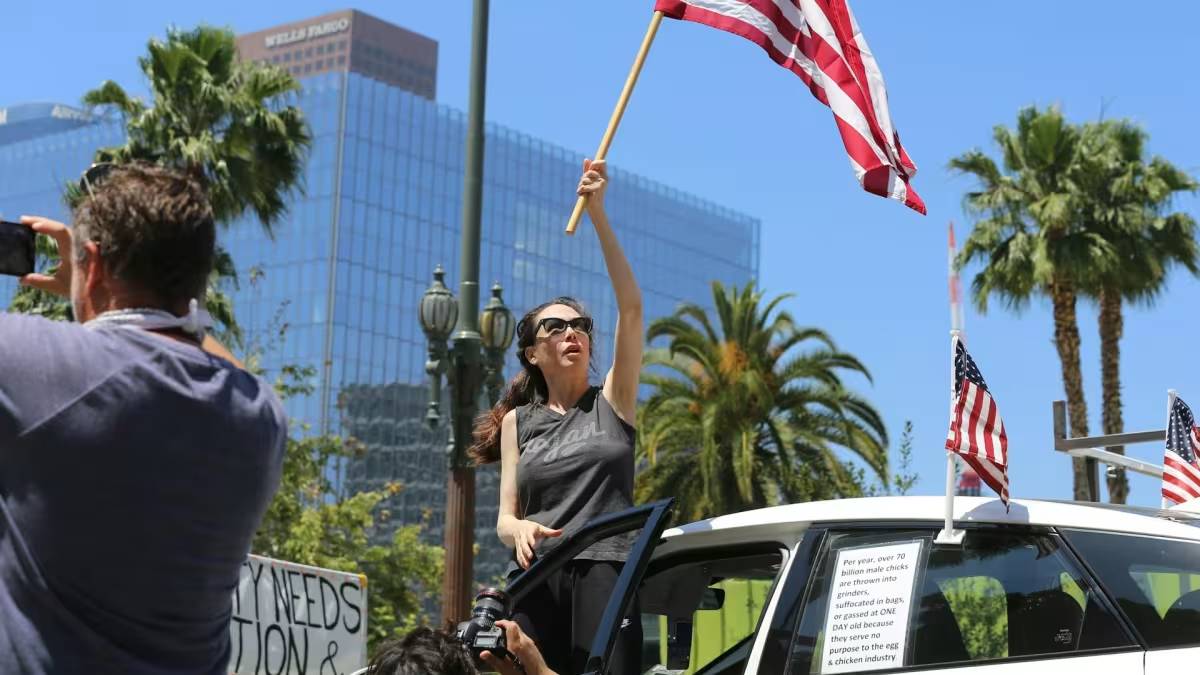
Nearly 18 months into Trump's second term, anti-democracy activism has not lost momentum. But walk into most resistance spaces and a striking pattern emerges: women dominate the movement while men have largely disappeared from the fight.
In a Brooklyn-based activist group that began with two male founders, the gender composition has shifted dramatically. During Trump's first term, the group was roughly 65% women. Since November 2024, after doubling in size, that figure has climbed to about 80%. The imbalance is so pronounced that seeing three male faces at a single event feels like strong masculine turnout.
Academic research confirms what organizers are witnessing on the ground. Dana Fisher, who studies civic engagement at American University, found that resistance participants are "predominantly white, highly-educated, female, and middle-aged." During the first Trump administration, scholars Laura Putnam and Theda Skocpol documented that women comprised 70% of participants and most leadership positions. The gender gap in political engagement cuts the other way when it comes to Trump support itself.
The exodus of men from organized resistance creates a self-reinforcing problem. As women and non-binary activists shoulder more of the work, men increasingly absorb the signal that activism is not their responsibility or space. A vicious cycle perpetuates itself, each woman-dominated event sending the subtle message that this fight belongs to someone else.
Some men have shifted ideologically to the right. Others have simply burned out, exhausted by the relentless demands of defending democracy. Still others have retreated into private life: work, family, hobbies, personal projects. The reasons matter less than the consequence: half the population has largely stepped back from the fight at a moment when organizers insist that maximum participation is essential.
For activists working to rebuild the pro-democracy majority, the absence is both frustrating and clarifying. Should men require personalized invitations to participate in building a better world? No. But do they? The evidence suggests yes. Organizers have come to accept an uncomfortable reality: direct appeals work. A new man joining a resistance group is cause for internal celebration, complete with reserved emojis marking the occasion.
One Brooklyn organizer has begun targeting fathers of school-age children, operating on the assumption that shared stakes in the future provide common ground. The thinking is straightforward: a parent fighting to preserve democracy for their child speaks a language that resonates across political divides. Even JD Vance might be a lost cause, but other fathers represent an untapped reserve of potential activists.
This summer, the organizer invited roughly half a dozen men to his apartment for pizza, beer, and conversation. Some attendees had already been active for years; others were taking their first step. The evening concluded with a concrete assignment: each man would personally invite three frustrated male acquaintances to participate in upcoming activist work. The message was clear: resistance will be built one person at a time, through direct personal connection.
The work continues on the ground. A recent May Day picnic and Shabbat dinner in Prospect Park drew more than 100 people, including 25 new email list signups. For organizers burning out from relentless work, those moments of community building and fresh faces offer genuine hope that the struggle can be sustained.
Author James Rodriguez: "Resistance movements need men in the room, but men won't show up without being asked, and that's a hard truth for organizers to swallow."
Comments