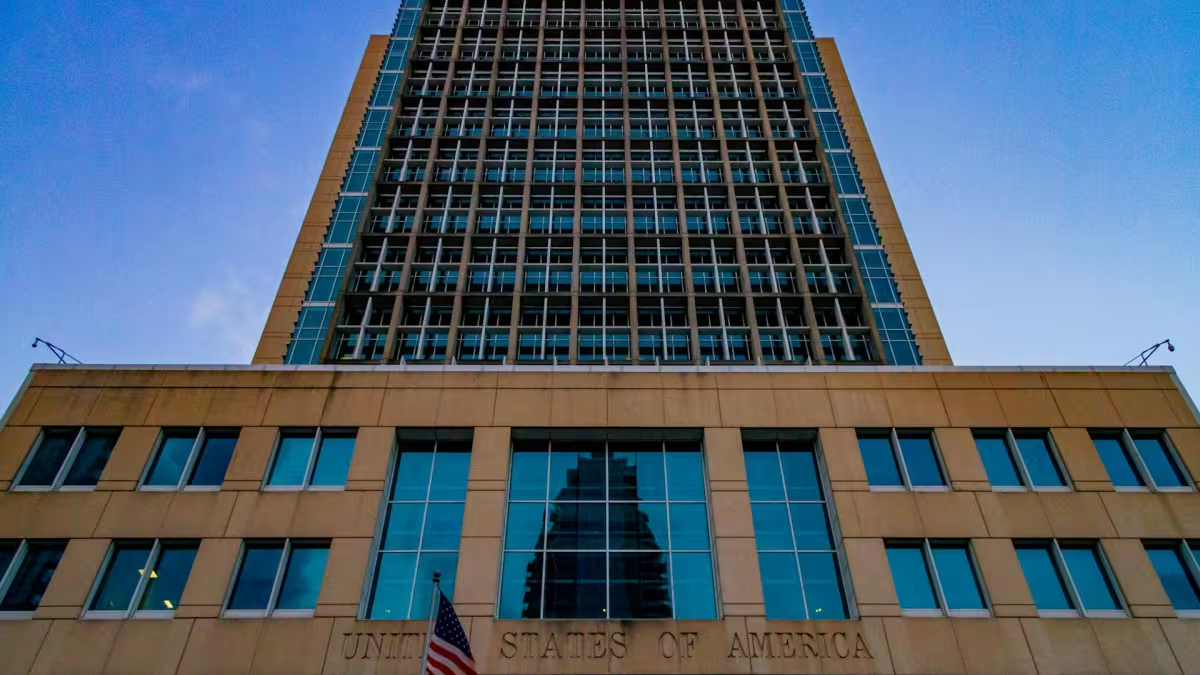
The Defense Department has not held a public press briefing in two and a half months, drawing fire from national security veterans and press freedom advocates who say the silence masks the true human cost of the conflict in Iran.
The accusation of a cover-up centers on how the Pentagon has disclosed casualties. Officials initially failed to publicize that 100 service members had been injured since early July, only acknowledging the figures after a social media post. The department later lowered reported troop deaths on its website from 18 to 14, attributing the discrepancy to a temporary technical error. At least 18 U.S. military personnel have been killed in the conflict, with roughly 430 injured overall.
Leon Panetta, who served as defense secretary and CIA director, told reporters the Pentagon was taking a shameful approach. "There's a deliberate effort here to basically withhold information from the American people," he said. Panetta held weekly briefings during the wars in Afghanistan and Iraq and contrasted that practice with the current blackout.
Officials justify the silence by arguing they are not required to publicize injuries if service members return to duty. The Pentagon spokesperson Sean Parnell stated the department has "consistently provided comprehensive, real-time updates" and that leadership delivers information directly through online channels.
Critics view the information strategy as deliberate. Ned Price, former deputy to the U.S. representative to the United Nations, said the withholding goes beyond typical press skepticism. "This is more about shielding the American people from the true and total cost of this war," he argued.
A broader pattern of media restrictions at the Pentagon compounds the problem. Since the conflict began five months ago, major news outlets including the New York Times, NPR, and Politico lost their Pentagon desk space, replaced by outlets favorable to the Trump administration. In October, most mainstream news organizations turned in their access badges rather than accept new rules that could result in expulsion for reporting unapproved information.
The Pentagon has imposed physical barriers as well. In June, the press office was declared a classified space off limits to journalists. March rules require reporters to be escorted by authorized personnel. These measures have alarmed international press freedom monitors.
Clayton Weimers, Washington director for Reporters Without Borders, said the Pentagon has been "more hostile to the news media than any other Pentagon in recent memory." Mark Schoeff, president of the National Press Club, called the restrictions unprecedented in his 34 years in Washington, including during the Gulf War and Afghanistan operations.
The shift is stark compared to the war's opening phase. Defense Secretary Pete Hegseth dominated early briefings with bombastic claims about annihilating the Iranian military. After unflattering images of him circulated, the Pentagon banned photojournalists. At one briefing, Hegseth likened reporters to biblical Pharisees, calling coverage an "endless stream of garbage."
Now that tone has flipped. Hegseth has avoided public engagements while announcing initiatives like screening troops for testosterone deficiency, prompting observers to question whether the military operation is deteriorating faster than officials admit.
Joel Rubin, former deputy assistant secretary of state, interpreted the communication vacuum as a sign of trouble. "When you're not able to communicate clearly what's actually taking place on the ground, that means you're likely not confident or comfortable with what is happening," he said.
The war has already cost $37.5 billion and remains deeply unpopular, driven by rising gas prices and broader economic strain. Ned Price noted that while informed Americans know 18 service members have died, fewer understand the broader injury toll. "There are hundreds, by one count some 500 U.S. service members, who have suffered physically as a result of this war," he said, suggesting the administration calculates that releasing full casualty data would further damage its standing ahead of elections.
Janessa Goldbeck, chief executive of the Vet Voice Foundation, echoed concerns about delayed reporting. "Modern warfare injuries might not be felt or seen until months or years later," she said, warning that withholding timely casualty reports raises questions about political motives.
The silence has not stopped the Pentagon's budget demands. At a Senate appropriations hearing this week, Hegseth was forced to defend endless funding requests while refusing to offer a coherent strategy. When Senator Gary Peters called the approach a complete failure, Hegseth snapped back: "Shame on you and others who call this a quagmire." Peters replied: "You, sir, are the failure. You don't have a strategy."
Steven Cash, former intelligence officer and executive director of the Steady State, a group of over 400 former national security officials, said the administration views the public and press as adversaries rather than stakeholders. "They've made it clear that they don't see a role for you, the media. You are an enemy," he said.
Despite the restrictions, Pentagon beat reporters continue pursuing information through sources. Panetta predicted the effort to hide facts would ultimately fail. "In essence what they're doing is challenging the press to find what's really happening, and they will," he said. "No matter how much you try to hide it, in the end, the truth comes out."
Author James Rodriguez: "The Pentagon's silence speaks louder than any briefing ever could, and it's become the administration's worst kept secret."
Comments