The Trump administration is reshaping its public case for the ongoing conflict with Iran, pivoting from earlier promises of diplomatic resolution to a narrower focus on keeping energy supplies flowing through a critical shipping lane. The shift comes as American combat deaths accumulate and Democratic critics challenge the war's fundamental justification.
Energy Secretary Chris Wright defended the strategy on ABC's This Week on Sunday, acknowledging that initial timelines for ending the conflict have slipped. Wright said the administration attempted negotiations to allow Iranian cooperation on oil passage but abandoned that approach after what he called Iranian refusal to comply.
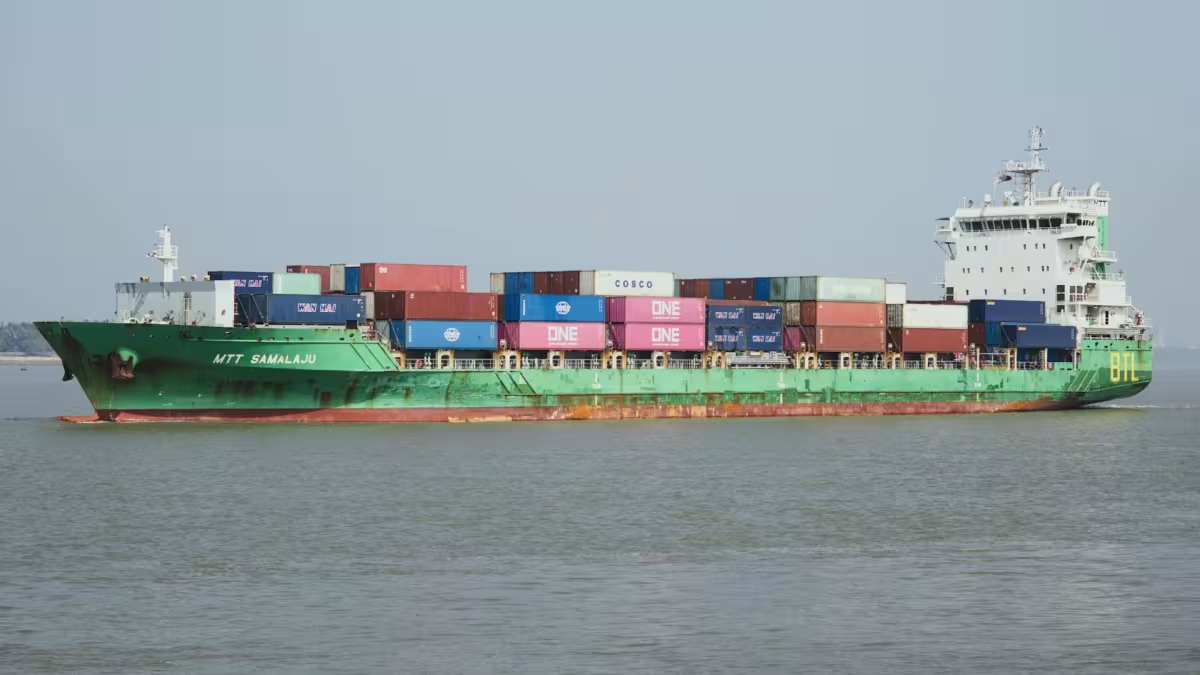
"Now, what we're doing is assuring that that oil and gas and other products can flow through the strait of Hormuz with or without Iranian cooperation, and we've continued to degrade their offensive military capabilities," Wright said.
The war, which began in February, has killed 16 American military members, including two troops who died in Jordan on Friday. Those deaths prompted the US military to launch retaliatory strikes against Iran's Revolutionary Guards on Sunday as fighting intensified in the second week of a renewed campaign around the strait.
Defense Secretary Pete Hegseth responded to the latest casualties with a vow to press forward, posting on social media that the fallen service members' "sacrifice only stiffens our resolve."
Senator Mark Warner of Virginia challenged the entire enterprise on the same broadcast, framing it as a war launched without imminent threat and measuring it against the administration's original stated goals. He argued the US has failed on multiple fronts.
Warner pointed to the absence of progress on regime change, the continued presence of enriched uranium that the administration sought to remove, and the persistence of Iranian missile and drone capabilities. He estimated that neutralizing Iran's nuclear material would require a minimum of 15,000 troops deployed for a week to extract volatile canisters from underground bunkers.
"The continuation of this war, at this pace, will be a continuing disaster," Warner said.
The Democratic criticism reflects broader party concerns about the conflict's scope and costs. Warner's characterization of the war as a "war of choice" without an imminent trigger stands in sharp contrast to the administration's security rationale for military action.
President Trump himself escalated pressure on Iran on Sunday, calling on Congress to add Iran to pending Russia sanctions legislation. The move would undermine a June memorandum of understanding between the US and Iran that was designed to resolve the conflict and included sanctions relief for Tehran.
Trump's push referenced the death of Republican Senator Lindsey Graham, his political ally, who had advocated for including Iran in Russia sanctions before his unexpected death on July 11.
Author James Rodriguez: "The energy secretary's admission that the mission has fundamentally changed is a remarkable concession that early predictions fell flat, and it raises the question of what happens if Iran refuses to cooperate with an increasingly narrow objective."
Comments