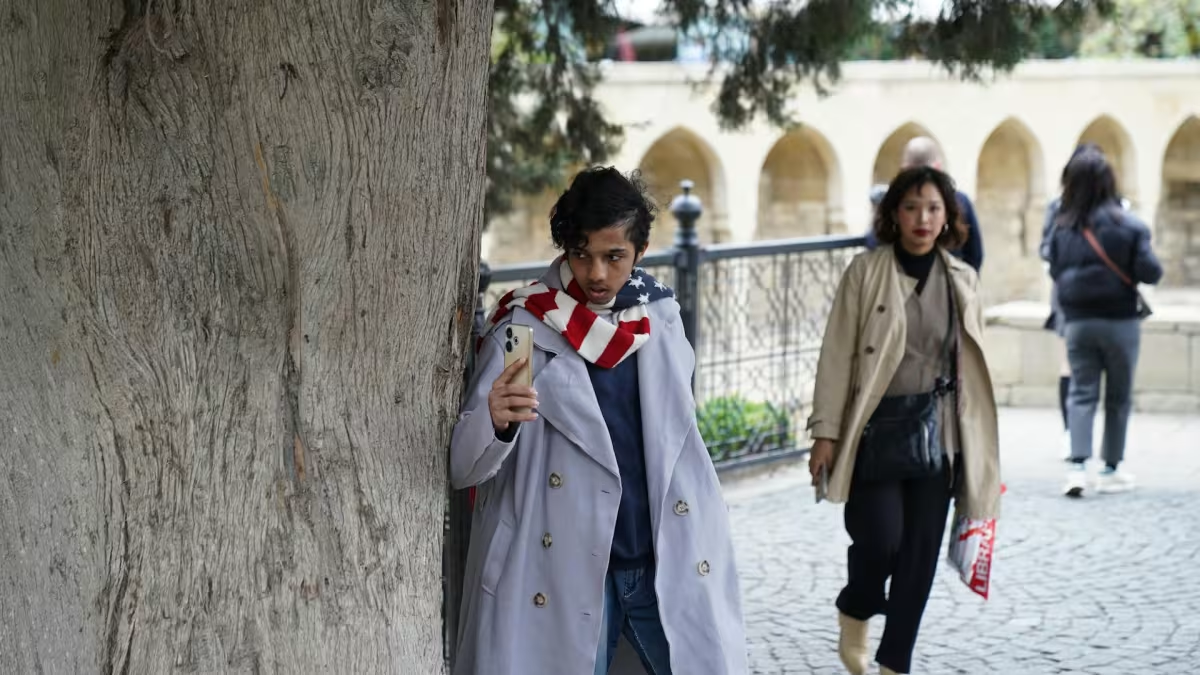
Ten months after his death, Charlie Kirk has become the internet's favorite punchline. The far-right activist's name and face are everywhere online, but not in the way his supporters would have hoped.
Memes of Kirk have proliferated across social media with startling speed and crude humor. Audio of the gunshot that killed him became a TikTok meme. An AI-generated tribute song meant to honor him is now shared ironically. He was mocked during a Netflix roast. Internet users have created a trend called "Kirkification," superimposing his face onto random images from the Mona Lisa to Jeffrey Epstein.
This stands in sharp contrast to the period immediately after Kirk's assassination in September, when conservative figures actively suppressed criticism of him. Hundreds of people faced firing or discipline for speaking negatively about the MAGA luminary, leading to several settlements over alleged First Amendment violations.
That censorship backfired spectacularly. Media sociologist Alex Turvy, author of an upcoming book on internet culture, explained the mechanism: "When you mandate reverence on a medium built for irony, you don't freeze the image, you load the spring. A lot of the mockery was that pressure releasing."
The meme-ification has damaged the careful legacy Kirk spent his lifetime building. It has also overshadowed the prosecution of his alleged shooter, Tyler Robinson, who faces the death penalty. Preliminary hearings began this week in Provo, Utah.
Kirk's organization, Turning Point USA, has struggled to maintain its grip on online discourse since his death, even with his widow Erika leading the group. Other right-wing figures have moved to fill the vacuum he left behind.
Eviane Leidig, director of research and outreach at the Center for the Study of Organized Hate, pointed to deeper shifts in conservative youth culture. "A lot of young people are looking at him and the legacy of his messaging and thinking that it's really cringe," she said. "It's not cool anymore."
Kirk had built his career as MAGA's youth whisperer, generating viral moments that expanded the Republican party's reach among younger voters. His commentary was often inflammatory. In 2023, he declared that "in urban America, prowling Blacks go around for fun to go target white people." In 2025, he criticized Taylor Swift for not submitting to her then-fiance Travis Kelce.
His influence rested on a specific formula. Kirk traveled the country challenging college students to debates, participated in online political confrontations with liberals, and created content designed purely for virality. Jamie Cohen, an associate professor of media studies at CUNY Queens College, described him as fitting into a collective of "media martyrs" who claimed countercultural status while actually manufacturing outrage for clicks.
The speed of Kirk's transformation from martyr to meme has shocked observers. Previously, it took years for major tragedies to become fodder for cynical internet humor. The attacks of 9/11 took nearly a decade. Kirk was meme-ified in weeks, enabled by generative AI and image-editing tools that allow anyone to participate.
Turvy noted that in previous eras, major events would have produced a unified national narrative, shaped by the press, government, and political institutions. "What's different now is that online everyone has a roughly equal-sized megaphone," he said. "Every camp can reach for the meaning of his death, and none of them can make theirs stick. The memes are what fill the space where a settled meaning used to go."
Turning Point's struggles extend to Erika Kirk herself. She and her husband had promoted traditional gender roles and female subservience. Now she leads a multimillion-dollar organization, and her quick return to public life has made her a target for often misogynistic online ridicule.
Under Charlie's leadership, Turning Point operated through a calculated "top-down approach" with cohesive messaging, major funding, and White House support. Without broad acceptance of Erika's leadership, the organization has weakened considerably. Other figures, including white nationalist Nick Fuentes and his followers known as Groypers, have ascended in the power vacuum.
The upcoming trial may offer Kirk's supporters a chance to reshape the narrative around his death and legacy. For now, his image appears locked in amber as internet comedy material.
Author James Rodriguez: "The internet has turned a political martyr into a cautionary tale about what happens when you build a career on manufactured outrage."
Comments