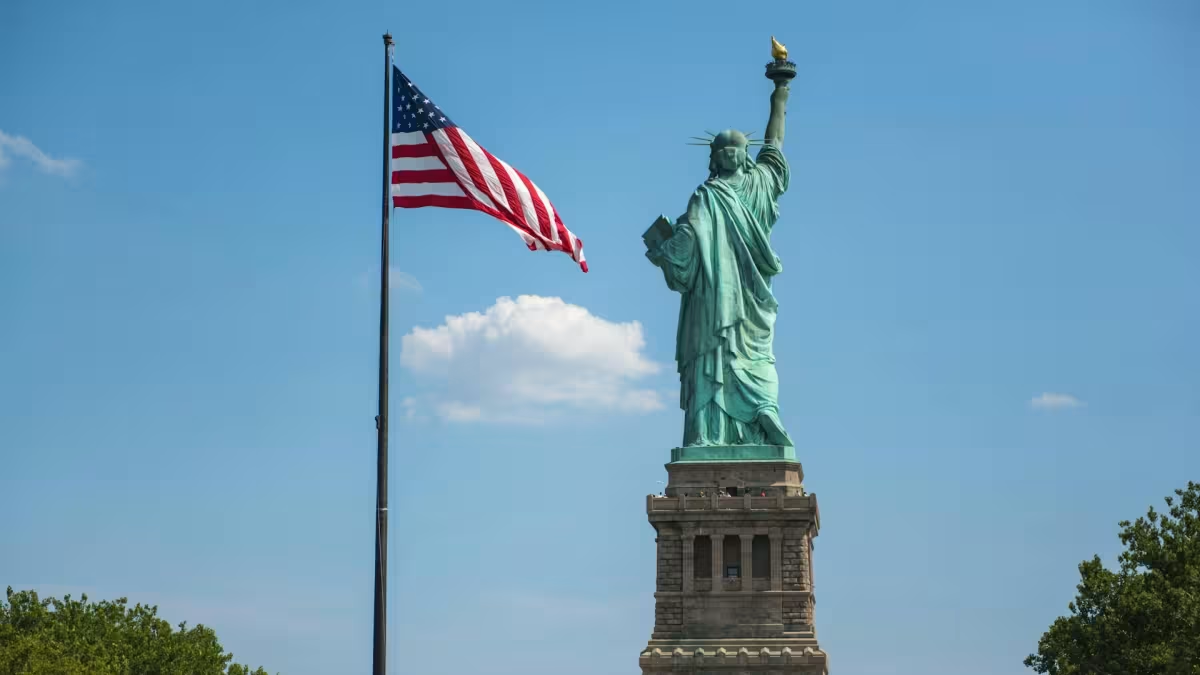
This Saturday marks the official celebration of America's 250th year, but the mood in the country suggests little appetite for pageantry. A Pew Research Center survey found that 69% of Americans expressed dissatisfaction with the nation's direction early this year. That figure reflects something deeper than typical political grumbling: it is a clear-eyed assessment of structural damage.
The Supreme Court's recent decisions offered a window into exactly what that damage looks like. In a span of days, the justices preserved one critical constitutional protection while systematically weakening others, laying bare the fragility of rights Americans often assume are settled.
The court blocked a presidential executive order that sought to strip birthright citizenship from children of undocumented and temporary residents. That victory was real, but it lasted only hours. The president immediately signaled his intent to pursue the same goal through Congress, despite the constitutional impossibility of such a move through ordinary legislation. One justice, Brett Kavanaugh, had left a door ajar in his concurrence, suggesting Congress could carve out exceptions by statute. A protection upheld in the morning, marked for demolition by afternoon.
Birthright citizenship itself was not handed down by the founders. It was a repair, built into the 14th Amendment after the Dred Scott decision, after slavery, after a war that nearly destroyed the nation. Justice Ketanji Brown Jackson's concurrence described the Reconstruction amendments as an anticaste reset, not mere treatment for a historical wound. The founding promise of equality did not preserve itself. It had to be rebuilt into the Constitution after the nation's highest court exposed the lie underneath the celebration.
The same week, the court dismantled decades-old campaign finance limits. Republican campaign committees had challenged restrictions on how much a party could spend in direct coordination with its candidates. Those limits prevented donors from purchasing through the party what they could not purchase directly. Now that guardrail is gone, opening a direct pipeline from wealth to political power.
The court also upheld state laws banning transgender girls from competing in girls' sports, declining to examine whether such bans actually served the stated interests or simply authorized discrimination against a single category of people. That is not equal protection under law.
Meanwhile, Congress passed a rare bipartisan housing bill designed to make homes easier to build and afford. The president cancelled the signing ceremony, dismissing the legislation as a big yawn. He called a voting restriction bill a National Emergency instead. The difference was stark: material repairs to help people live with dignity took a back seat to measures that would make registration harder.
A republic does not survive on celebration. It survives on repair. That repair is unglamorous work: protecting democracy, defending civil rights, building homes, limiting the influence of money, and preserving the collective memory of what has been broken and why. Memory itself is a form of repair. Distortion and reframing allow old hierarchies to return in new language.
A country can be taken apart slowly, lawfully, one ruling at a time. The people doing it are not vandals but officials operating within the system. The answer is not fireworks, and it is not despair. It is to name plainly what is being damaged, and by whom, then to get to work fixing it.
Author James Rodriguez: "When a country gets to 250 years, the real test isn't whether you throw a good party, it's whether you're willing to do the hard work of holding power accountable."
Comments