Janeese Lewis George, a Democratic socialist on the D.C. City Council, has built a substantial lead in the Democratic primary for mayor as ballots continue to be counted, putting her on track to become one of the nation's highest-profile democratic socialists to win a major city's top office.
With roughly two-thirds of expected votes tallied, Lewis George holds 53 percent of first-place votes. Former City Council member Kenyan McDuffie trails at 37 percent, with five other candidates dividing the remainder. The race could trigger a ranked-choice tabulation if no candidate reaches an outright majority once all votes are counted, but Lewis George's current margin suggests she has built a commanding position against her main rival.
The primary has centered on how the next mayor will confront two persistent challenges facing Washington: rising crime and housing affordability. Lewis George and McDuffie have also sparred over the incoming administration's relationship with President Donald Trump and congressional Republicans, a dynamic that took on new urgency last week when Trump warned he would consider a federal takeover of the capital if Lewis George wins.
"We won't put up with it," Trump told reporters at the White House, referencing her potential victory and signaling he could move to strip the city of its limited home-rule authority. Lewis George responded sharply, framing his statement as an assault on democratic principles.
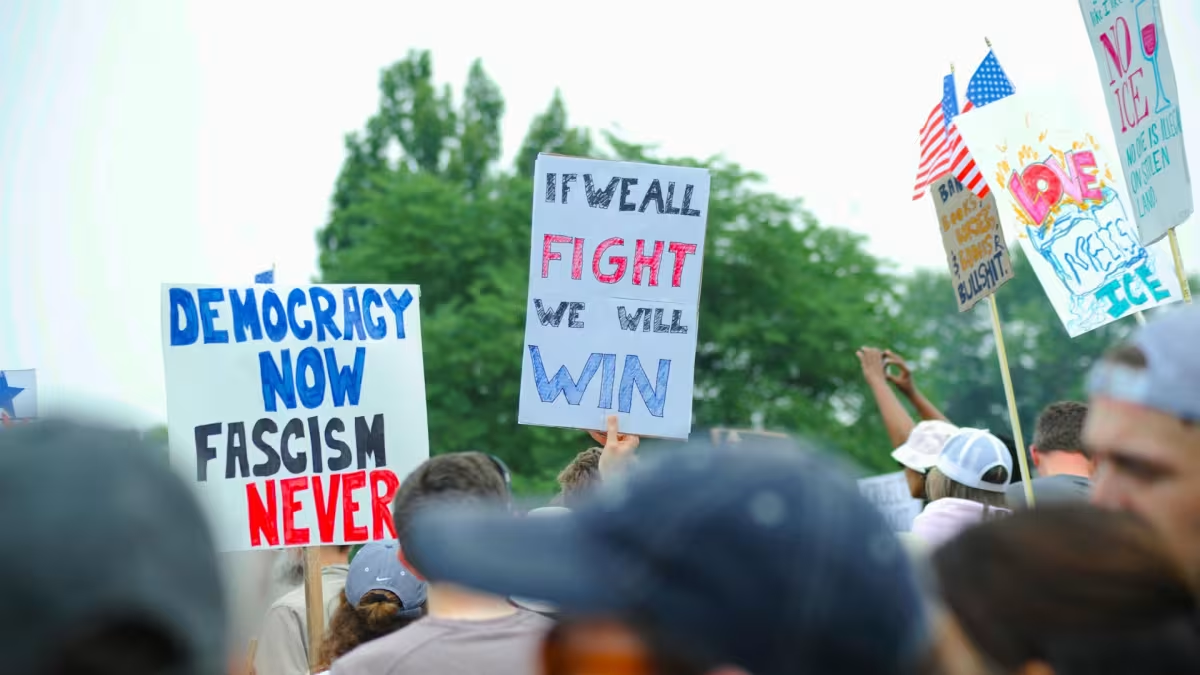
"Threatening Home Rule because you do not like how residents vote is an attack on democracy itself," she said. "The people of D.C. elect the mayor of D.C. And they want someone who will stand up to Donald Trump."
McDuffie, too, pushed back against Trump's intervention, saying voters, not the president, would decide the race. But McDuffie has positioned himself as someone willing to work across party lines. Retiring Mayor Muriel Bowser, who had a sometimes tense relationship with Trump during his first term, endorsed McDuffie earlier this month and called for the next mayor to foster a stronger business climate in the nation's capital.
The two frontrunners also diverge on public safety tactics. McDuffie supports expanding youth curfews as a practical anti-crime measure, while Lewis George opposes broadening curfew policies. That fault line reflects a broader philosophical divide between the two candidates over how aggressively to police the city.
Whoever wins the Democratic primary will be the overwhelming favorite in November. Washington, D.C. is solidly Democratic, meaning the general election is largely a formality. If elected, Lewis George would join a small but growing cohort of self-described democratic socialists leading major American cities, adding to the recent ascent of figures like New York Mayor Zohran Mamdani.
The primary also comes at a moment of heightened tension between the capital and the Trump administration. During Trump's second term, the White House has deployed National Guard personnel to Washington and other cities led by Democratic mayors to address violent crime. Bowser opposed the deployment but ultimately accepted it, a decision that may inform how voters assess the candidates' ability to navigate relations with the federal government.
Author Sarah Mitchell: "Lewis George's lead is substantial enough that even ranked-choice voting may not save McDuffie, and Trump's direct threat to the city appears to have energized her base rather than intimidated it."
Comments