Vice President JD Vance credits his wife Usha with reshaping his upcoming memoir "Communion," describing her as a tough editor who refused to let weak material survive. "She doesn't sugarcoat things," Vance said in an NBC News interview Tuesday. "She's very direct."
The second lady was involved in nearly every stage of the book's creation, set for release June 16 by HarperCollins. She helped reorganize chapters, cut passages that lacked substance, and served as a central character in Vance's narrative of spiritual transformation. "Fundamentally, the book wouldn't exist without her," Vance said.
That role carries particular weight given that Usha Vance is Hindu. The vice president has described his journey from Protestantism through atheism and finally to Catholicism as one his wife actively supported, despite not sharing his faith. "I don't think I would be a Christian today were it not for my wife," he said.
The characterization stands in contrast to criticism Vance faced last fall after expressing hope that his wife might one day convert to Christianity. When asked about the backlash Tuesday, Vance framed his remarks as a straightforward observation about wanting to share his faith with those closest to him. "And I'm OK with that," he said of the likelihood she won't convert. "What I'd say about Usha is that one of the things I love about her is that she's brilliant, but she's also fiercely independent."
"Communion" follows his 2016 bestseller "Hillbilly Elegy," which became a film and launched his public profile years before he entered politics. An excerpt published this month by USA Today centered on how Vance fell in love with his wife, the former Usha Chilukuri.
During the 25-minute call, Vance discussed how faith themes have shaped his political career since becoming a senator in 2023 and Trump's running mate 16 months later. He credited his position as vice president with deepening his faith, citing what he described as unexplainable moments. "I've just seen things that feel like they're way too unusual to just be coincidences or luck or chance," Vance said, mentioning well-timed phone calls and prayers offered to him since taking office.
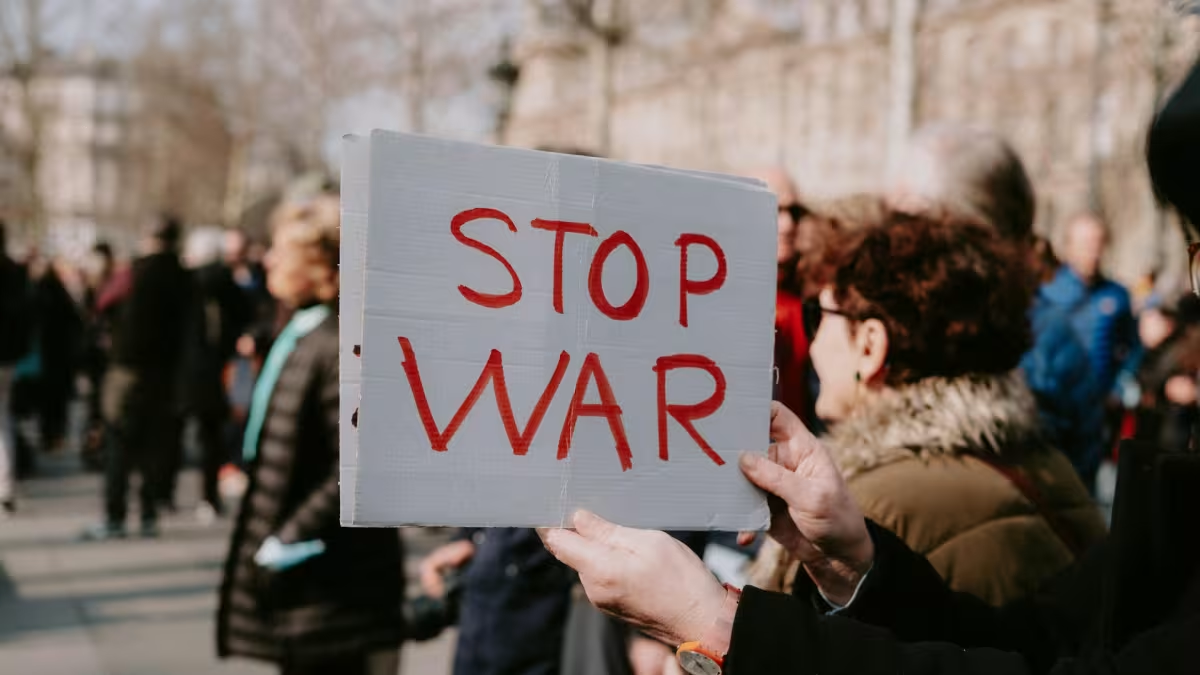
On matters of war and governance, Vance said his Catholic faith informs his application of "just war" theory, requiring leaders to examine whether military action is morally justified. That framework has guided his approach to the Iran conflict, where his earlier skepticism about the operation has given way to defense of Trump's decision. "I find myself constantly asking myself, 'Is this justified? Is this moral? Is this the right thing to do?'" Vance said. "And that does provide a limitation on political leaders, as it should."
Vance expressed hope that Iran will accept nuclear restrictions as part of any peace deal, though he identified verification as the harder challenge. "The more difficult question is whether they agree to the kind of enforcement mechanism, the kind of monitoring mechanism, that gives us confidence that they won't violate the deal in the future."
The vice president also addressed Republican concerns over a proposed $1.776 billion "anti-weaponization" fund that some fear could compensate Trump allies, including those involved in the January 6 Capitol riot. Senate Republicans have delayed a vote on the measure as part of broader immigration funding. Vance acknowledged the need for oversight when spending public money but framed compensation for those wronged by the legal system as a foundational American principle. "I think in some ways the discussion around the fund distracted from that underlying principle, which is very important."
On speculation about potential 2028 presidential contenders, Vance deflected questions comparing him to his longtime friend Marco Rubio, now secretary of state. Trump has fueled such speculation by frequently mentioning both men in tandem and polling his audiences about succession. "To honestly answer those questions, I would have to be a candidate for president myself, and I'm not," Vance said. "If I ever become a candidate for president, the attitude I would bring to it is I'm not entitled to it, right?"
Vance praised Rubio's influence on his own political thinking, particularly regarding Catholic approaches to economics and trade policy. "Marco's Christianity is constantly influencing how he thinks about his job, how he thinks about the big principles that we're applying."
Author Sarah Mitchell: "Vance's willingness to place his wife at the center of his faith story, and to acknowledge her skepticism while crediting her influence, suggests someone grappling with real complexity rather than trading in easy answers."
Comments