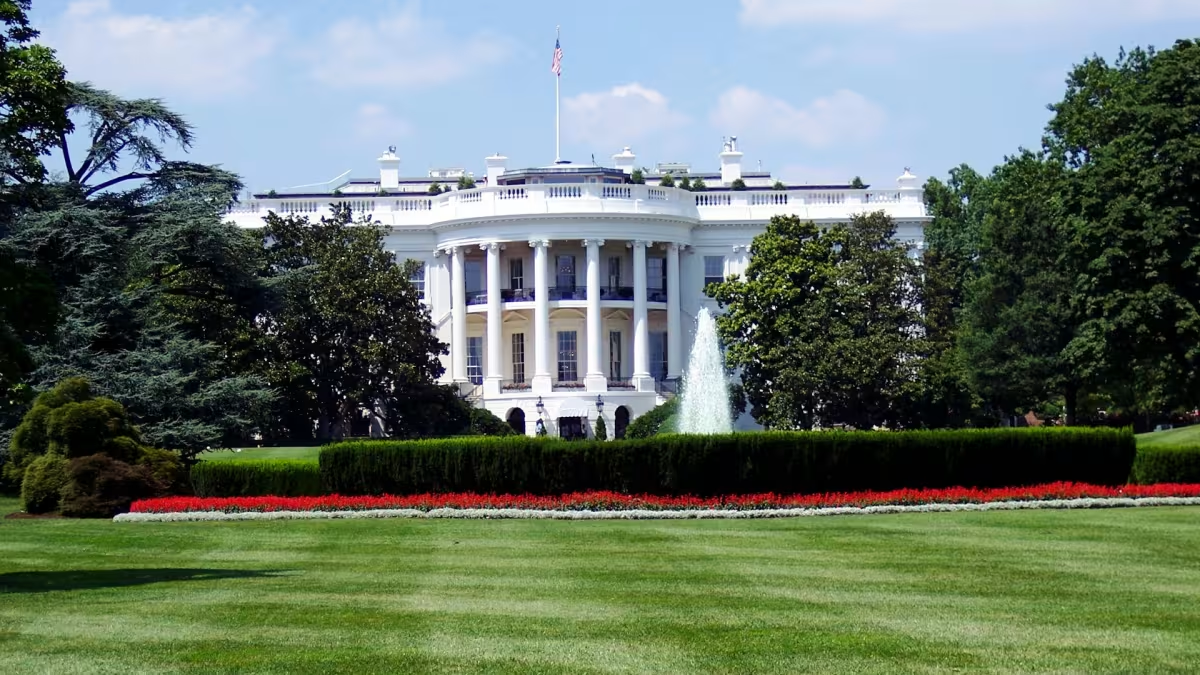
The gleaming 90,000 square-foot ballroom rising on White House grounds may test the patience of Republican unity. What President Trump once hailed as an entirely private gift to the nation, funded by corporate donors without a dime of federal money, has now morphed into a $1 billion taxpayer obligation buried in legislative fine print.
Senate Judiciary Committee Chairman Chuck Grassley, R-Iowa, inserted the security funding into a long-term immigration and border patrol bill that the GOP plans to pass this year as a party-only "reconciliation" measure. The $1 billion allocation targets "security adjustments and upgrades, including within the perimeter fence of the White House Compound" and covers "above-ground and below-ground security features" tied to what the administration calls the East Wing Modernization Project.
The financial reversal stands in sharp contrast to Trump's repeated assurances last year. "Not one penny is being used from the federal government," the president told reporters in the Oval Office last November, describing donations from patriotic private individuals. In January, he doubled down on social media, calling the project "a GIFT (ZERO taxpayer funding!) to the United States of America" worth 300 to 400 million dollars.
Trump demolished the historic East Wing to clear space for the ballroom, which he framed as a modern solution to an old problem. Foreign leaders visiting for state dinners would no longer have to sit under makeshift tents on the South Lawn. Major corporations, including Comcast, the parent of NBCUniversal, contributed millions to underwrite construction costs.
As the project advanced, the White House's justification shifted. Court filings last month stressed that the structure is "vital" for presidential security and will be built with materials capable of withstanding drone attacks. The administration also revealed that the ballroom sits atop underground medical facilities and a bomb shelter. That messaging intensified after a gunman stormed the White House Correspondents' Association Dinner last month, where Trump was seated at the dais in a Washington hotel.
White House spokesman Davis Ingle defended the new funding in a prepared statement, citing the assassination attempt and the need for the Secret Service to "fully and completely harden the White House complex." The proposal frames the security enhancements as a critical national security imperative tied to recent threats.
Senate Democrats plan to challenge the provision when the bill reaches the floor later this month. "Just flagging that now everyone gets an up or down vote on the ballroom!" Sen. Brian Schatz, D-Hawaii, posted on X, signaling that the party will force members to publicly state their position on taxpayer funding for the project.
Critics on the left framed the funding request as a bait-and-switch that contradicts the president's original pledge. Sen. Richard Blumenthal, D-Conn., told NBC News: "This has been a bait and switch: promising it would be privately funded and now, apparently, taxpayers will be on the hook for it." Sen. Chris Coons, D-Del., called it "tragically another example of President Trump promising one thing and doing another," noting that the true cost now exceeds $1 billion without clarity on the breakdown.
The ballroom project faces separate legal jeopardy. Plaintiffs have challenged Trump's authority to demolish the East Wing without congressional approval. A federal appeals court will hear arguments next month on whether the administration can proceed with construction while that challenge moves forward. A decision is not expected until mid-June at the earliest.
Author Sarah Mitchell: "This is the kind of legislative sleight of hand that breeds contempt for both parties, but the GOP is playing with fire if it expects rank-and-file Republicans to rubber-stamp a $1 billion reversal on Trump's personal project without a fight."
Comments