New York authorities have returned more than 650 antiquities worth $14 million to India, a decision that comes as the city's newly elected mayor challenged Britain to give back one of history's most contested gems.
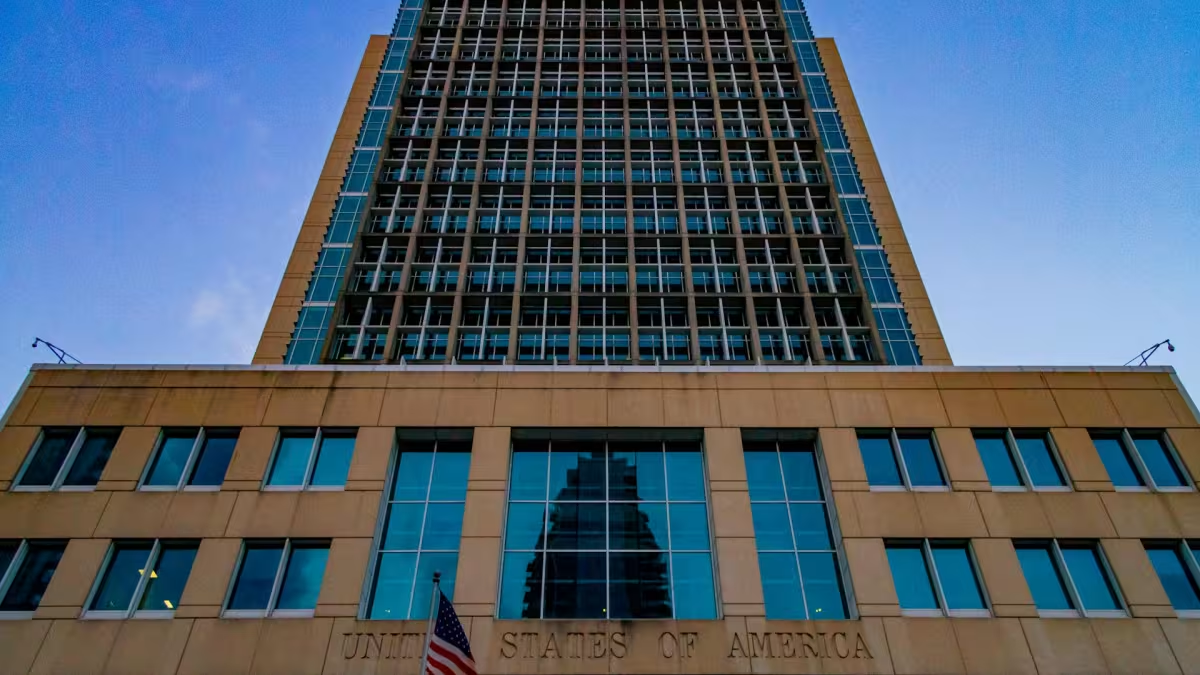
Manhattan District Attorney Alvin Bragg Jr. announced the handover of 657 pieces on Tuesday at a ceremony held at India's consulate general. The collection includes sculptures, religious artifacts, and items recovered from multiple ongoing investigations into smuggling networks that moved Indian cultural property into the United States.
Among the returned works is a bronze figure of Avalokiteshvara, a Buddhist deity seated on a double-lotus throne flanked by lions, which had been stolen and smuggled into the country by 1982 before ending up in a private New York collection. Also included are a sandstone Buddha figure looted from northern India and smuggled by alleged art trafficker Subhash Kapoor, who faces indictment on smuggling charges. A dancing Ganesha sculpture taken by an indicted co-conspirator rounded out the notable pieces.
"The scale of the trafficking networks that targeted cultural heritage in India is massive, as demonstrated by the return of more than 600 pieces today," Bragg said at the ceremony. "There is unfortunately more work to be done to return stolen artifacts back to India, and I thank our team for their persistent efforts."
The timing raised eyebrows when New York City Mayor Zohran Mamdani, the city's first democratic socialist chief executive, used the moment to make pointed remarks about the Koh-i-noor diamond. The 105.6-carat gem, currently set in the Queen Mother's crown and housed in the Tower of London, has become a lightning rod in debates over colonial-era acquisitions and ownership claims.
Hours before shaking hands with King Charles at the 9/11 memorial on Wednesday, Mamdani told reporters that Britain should return the diamond to India. When asked whether he might raise the matter directly with the monarch, Mamdani said he "would probably encourage him to return the Koh-i-noor diamond" if given the chance.
The mayor's office initially did not disclose the meeting with Charles, describing his Wednesday schedule only as a "wreath-laying alongside a number of other elected officials." A spokesperson later confirmed the encounter occurred.
The Koh-i-noor has passed through numerous empires, including the Mughal and Persian dynasties, before Britain acquired it in 1849. Today, India, Pakistan, Iran, and Afghanistan all claim rights to it. A spokesperson for Mamdani, who was born in Uganda to parents of Indian descent, noted that the mayor "is generally opposed to the idea of a king." The administration has emphasized New York's history as "one of colonization, exploitation and racial oppression."
According to William Dalrymple, co-author of the 2017 book Koh-I-Noor: The History of the World's Most Infamous Diamond, the stone "has a long history of bringing bad luck and, again, seems to have been the tripwire which tripped up King Charles on his trip to New York."
The prosecutor's office said the artifact return ceremony had been scheduled months in advance and was unrelated to the royal visit. The gesture is expected to intensify pressure on other institutions and governments to repatriate cultural property to its countries of origin.
Author James Rodriguez: "Mamdani's move puts the British monarchy on the defensive right in front of the cameras, transforming a repatriation ceremony into a direct challenge over one of the world's most famous disputed artifacts."
Comments