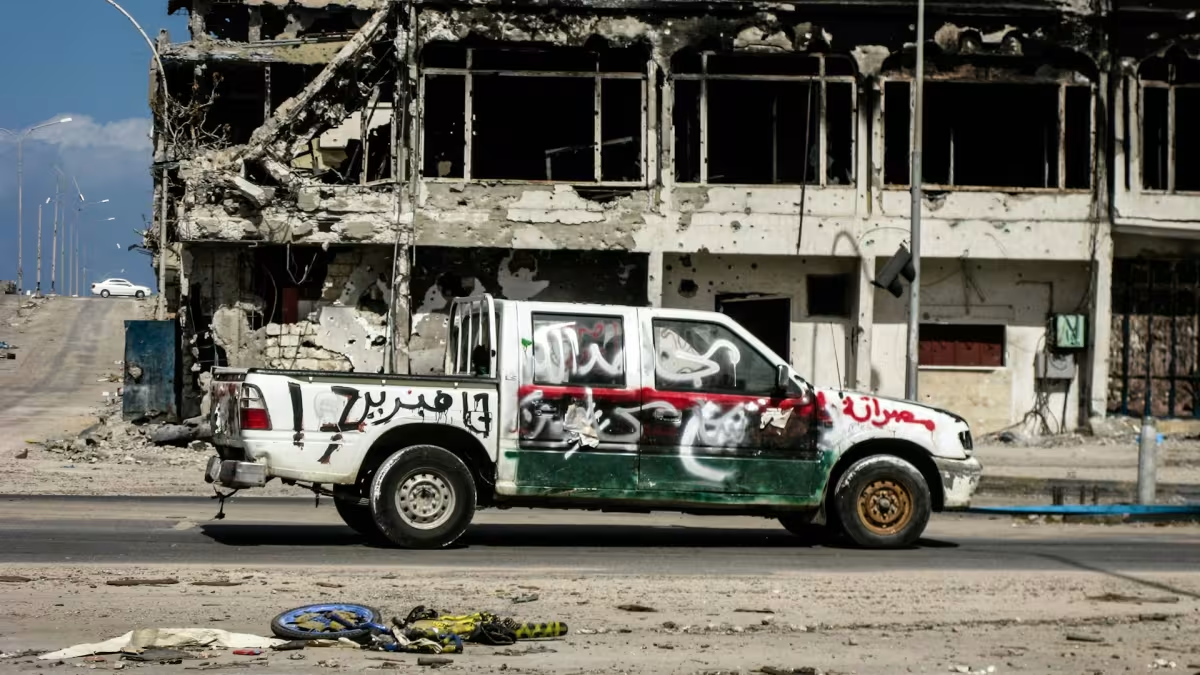
Iran is frantically digging out missiles and munitions buried underground or trapped beneath rubble from recent U.S. and Israeli airstrikes, according to U.S. intelligence officials and sources familiar with the operation. The accelerated excavation effort reflects Tehran's calculation that a fragile ceasefire could collapse at any moment, threatening to resume a conflict that has already decimated much of its arsenal.
The recovery work intensified as negotiations to end the war have stalled. A temporary ceasefire took effect on April 8 to create space for diplomatic talks and reopen the Strait of Hormuz, which Iran had blocked in late February. But discussions have yielded no breakthrough, and both sides are bracing for possible renewed combat.
President Trump is expected to decide within days whether to resume military operations. A Thursday meeting with his national security team, including Admiral Brad Cooper of U.S. Central Command, will review options that range from new airstrikes to forcing open the strategic waterway and eliminating Iran's nuclear material. The timing of Trump's planned mid-May trip to China, where he will meet with President Xi Jinping, is factoring into his decision-making process.
Defense Secretary Pete Hegseth made plain what Washington knows about Iran's movements. In remarks at the Pentagon on April 16, he stated: "We know what military assets you are moving and where you are moving them to." Hegseth noted that while Iran is "digging out of bombed-out and devastated facilities," the United States continues to strengthen its position. "You are digging out your remaining launchers and missiles with no ability to replace them," he said.
The Trump administration has touted the military campaign as a decisive success. White House spokesperson Anna Kelly said the U.S. military achieved all of Trump's objectives, claiming Iran's ballistic missiles are destroyed, production facilities demolished, its navy sunk, and proxy forces weakened. White House press secretary Karoline Leavitt predicted in late March that the war would wrap up within four to six weeks.
Yet intelligence assessments paint a more complex picture. U.S. officials acknowledge that Iran retains roughly half of its ballistic missile arsenal, more than half of its air force aircraft, and more than half of the Islamic Revolutionary Guard Corps' naval fleet. Before the war began, Iranian officials had deployed decoys and dispersed weapons across the country. The regime also buried or concealed additional missiles and launchers as the U.S. built up military assets in the region.
Trump himself acknowledged the reality on Wednesday, stating that Iran has lost about 82 percent of its missiles and most of its drones, but still possesses some of each. Secretary of State Marco Rubio, who is also serving as interim national security adviser, told Fox News that Iran retains half of its missile arsenal despite the strikes.
The stakes over the Strait of Hormuz remain enormous. Iran's blockade of the waterway, through which roughly 21 percent of the world's oil transits, sent global energy prices soaring. Trump responded by establishing a naval blockade of Iranian ports. As of Wednesday, the U.S. had redirected 41 vessels from the strait and maintains a significant military presence in the region.
Rubio highlighted Iran's broader vulnerability. The country faces severe economic pressure from global sanctions, a crippling drought, difficulty meeting government payroll obligations, and a collapsed economy. "They have half the missiles, none of the factories, and no navy and no air force. All that's been destroyed," Rubio said. Yet even in that weakened state, Iran is racing to recover what weapons it can before the fragile truce shatters.
The White House maintains that Trump's preference remains diplomacy, with instructions for negotiators to pursue a deal that prevents Iran from obtaining nuclear weapons. But the accelerated weapons retrieval and the upcoming decisions on military options suggest both sides are preparing for escalation rather than settlement.
Author Sarah Mitchell: "Iran's frantic dig-out is a tell that Tehran knows this ceasefire is on borrowed time, and it's betting that recovered missiles matter more than negotiated peace."
Comments